The Man Who Believed in Faeries
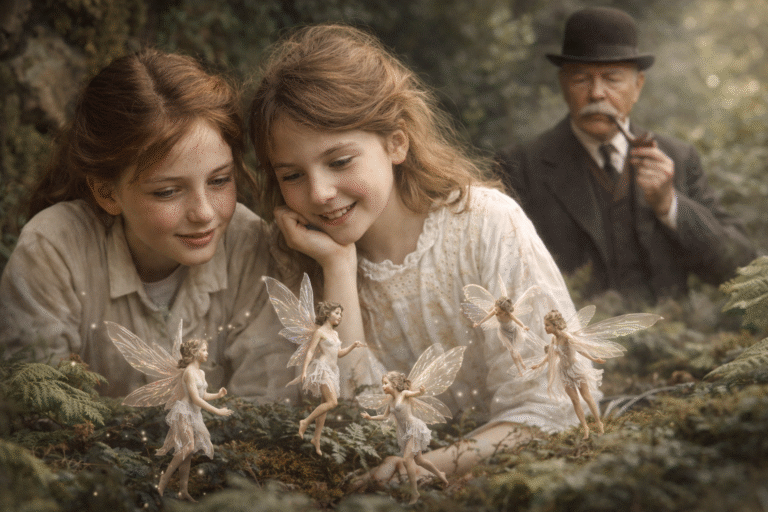
Fooling Sherlock Holmes’ Creator
Arthur Conan Doyle created Sherlock Holmes, the world’s most famous detective. Holmes solved mysteries using logic and careful observation. He never accepted anything without evidence. Yet the man who created this brilliant detective was himself deceived by two young girls with scissors and a camera. The story of how this happened reveals something sad and human about one of Britain’s greatest writers.
Doyle was a successful doctor before he became a famous author. He wrote stories about Sherlock Holmes that became incredibly popular. Doyle believed in science, evidence, and rational thinking. For most of his life, he seemed like the last person who would believe in magical creatures.
World War I changed everything. The war took the lives of millions of young men across Europe. Doyle’s oldest son, Kingsley, was wounded in battle in 1916. He survived his injuries but later caught influenza during the pandemic after the war. Kingsley died in 1918 at just 25. Within months, Doyle also lost his brother, two brothers-in-law, and two nephews. The grief was almost too much for him.
Like many who lost loved ones in the war, Doyle wanted to believe that death was not the end. He turned to spiritualism, which claimed that people could communicate with the dead. Mediums held séances and said spirits spoke through them. Doyle went to many of these gatherings. He wanted so much to reach his son that he started to believe the experiences were real. Even Houdini, the famous magician and Doyle’s friend, tried to show him that mediums used tricks. But Doyle could not accept it. He needed something to believe in.
In 1917, two cousins from the English village of Cottingley took some photographs that would later become famous. Elsie Wright was 16, and Frances Griffiths was 10. They spent hours playing by a stream near their home. When adults asked what they did, the girls said they played with fairies, but no one believed them. So Elsie borrowed her father’s camera and took a picture of Frances with what looked like four small fairies dancing in front of her. Later, they took another photo showing Elsie with a gnome.
The girls’ parents were confused. Mr. Wright, who worked with cameras, looked closely at the photos but could not explain them. Mrs. Wright, who was interested in spiritualism, thought the photos might be real. She shared them with her spiritualist friends. Eventually, the photos reached Edward Gardner, a well-known spiritualist in London. He had photography experts check the negatives. They said the pictures had not been changed. The fairies seemed real.
In 1920, Gardner showed the photographs to Arthur Conan Doyle. By then, Doyle was deeply involved in spiritualism. He was writing a magazine article about fairies and was excited to have photos as evidence. He met the girls and their parents, who seemed honest and sincere. Doyle reviewed the photos and spoke with experts. He wanted to believe, and everything seemed to support the idea that the fairies were real. He wrote articles saying the photos were real proof that magical creatures existed.
People reacted in different ways. Some believed the photos, while others were doubtful. They noticed the fairies looked a lot like drawings from children’s books. Still, Doyle strongly defended the photos. The girls took three more pictures in 1920, and Doyle promoted all five as real evidence.
For many years, people argued about the Cottingley fairy photos. The girls, now adults, never admitted to any trick. They grew tired of the attention and stopped talking about the photos. The mystery continued.
Then, in the 1980s, when Elsie was 81 and Frances was 76, they finally told the truth. The fairies were drawings. Elsie had copied pictures from a popular children’s book. She drew the fairies, cut them out, and held them up with pins. Frances posed behind them while Elsie took the photographs. It was a simple trick that fooled experts for more than sixty years. The old women said they had only meant it as a joke. They never expected adults to take the pictures seriously. When famous people like Doyle believed them, the girls felt trapped. They could not admit the truth without embarrassing important people.
Why did Arthur Conan Doyle believe in fairy photographs? The answer lies in his grief. He missed his son so terribly that he needed to believe in a world beyond what we can see. If fairies could exist, then perhaps spirits existed too. Perhaps death was not final. Perhaps his son was somewhere, somehow, still alive. His desperate hope overcame his usually careful thinking. He saw what he wanted to see.
This story shows that even smart people can be fooled when they really want something to be true. Grief, hope, and longing can affect our judgment. Arthur Conan Doyle created a detective who could see through any trick, but he could not see through a simple trick made by two children with scissors and imagination. It’s a sad irony, but also a very human one.
Take a moment to think about what you read.
Check your understanding
- What fictional character made Arthur Conan Doyle famous around the world?
A. Harry Houdini
B. Sherlock Holmes
C. Peter Pan
D. Dr. Watson - What major event deeply affected Doyle’s beliefs and outlook on life?
A. The Industrial Revolution
B. World War I and the loss of his family members
C. The invention of photography
D. His move from medicine to writing - What belief system did Doyle turn to after losing his son?
A. Astrology
B. Buddhism
C. Spiritualism
D. Psychology - Who took the photographs that appeared to show fairies?
A. Arthur Conan Doyle and Edward Gardner
B. Two journalists from London
C. Elsie Wright and Frances Griffiths
D. Photography experts from a magazine - How were the fairy photographs actually created?
A. By double exposure in a darkroom
B. By photographing dolls
C. By using reflections in water
D. By cutting out drawings and holding them with pins - Why did the girls wait so long to admit the photographs were fake?
A. They forgot how the photos were made
B. They were afraid of being punished by their parents
C. They did not want to embarrass famous people who believed them
D. They hoped to make money from the photos
Show answers
Answers:
- b
- b
- c
- c
- d
- c