Cryptids
Creatures that may or may not exist
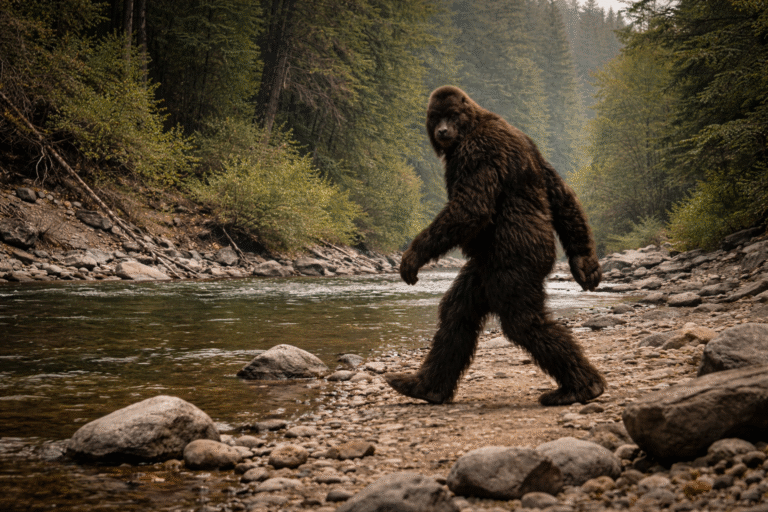
People in the Himalayas tell stories about a giant, ape-like creature with white fur called the Yeti, or Abominable Snowman. In the Pacific Northwest forests, hikers say they’ve seen a tall, hairy creature walking on two legs. Americans call it Bigfoot, and Canadians call it Sasquatch. In a deep Scottish lake, tourists hope to spot a long-necked monster swimming below the surface, known as the Loch Ness Monster or Nessie. These are all examples of cryptids, animals that science hasn’t proven exist. This leads to an intriguing question: Could science still surprise us? Are these creatures real, just myths, or is the truth somewhere in the middle?
The word “cryptid” comes from Greek and means “hidden.” Cryptozoology is the study of animals that people say they’ve seen but that science hasn’t confirmed. Supporters of cryptozoology point out that new species are found all the time. For example, the mountain gorilla was thought to be a myth until scientists proved it existed in 1902. The giant squid was once considered a sailor’s story until one washed up in the 1870s. The coelacanth, a fish believed extinct for millions of years, was found alive in 1938. If these animals turned out to be real, could others be too?
Bigfoot is probably the most well-known cryptid in North America. People describe it as a creature between seven and ten feet tall, covered in dark brown or reddish hair, with wide shoulders and long arms. It walks on two legs like a person and leaves huge footprints, sometimes up to 24 inches long. Over the past hundred years, thousands of people say they’ve seen Bigfoot. Some have taken blurry photos, others have recorded odd howling sounds in the woods, and a few claim to have filmed the creature itself.
The most famous piece of Bigfoot evidence is a short film made in 1967 by Roger Patterson and Bob Gimlin in Northern California. It shows a large, hairy figure walking across a clearing, looking back at the camera, and then disappearing into the trees. The creature moves with a unique stride and swings its arms. For over fifty years, people have argued about whether the film is real or a hoax. Some experts say the way it moves and its proportions don’t match a person in a costume. Others believe it’s fake because no one has ever found a body or bones.
The main problem with cryptids is that there is no solid physical evidence. Even though thousands of people say they’ve seen them, no one has ever found a body, skeleton, or even a clear photo. Skeptics say that since almost everyone has a camera now, the lack of good evidence means these creatures probably aren’t real. Believers argue that these animals are smart, rare, and live in wild places where people rarely go. They also note that even known animals can be very hard to photograph in nature.
The Loch Ness Monster presents another mystery. Loch Ness is a deep, cold lake in Scotland. For hundreds of years, people have said they’ve seen a big creature with a long neck and a humped back in the water. The modern story started in 1933, when a couple said they saw a huge animal crossing the road near the lake. Newspapers shared the story, and soon tourists began arriving at Loch Ness hoping to see the monster. Many photos have been taken over time, but most have turned out to be hoaxes or mistakes, such as logs or boats being misidentified.
Investigators have used sonar to scan the depths, searching for large moving objects. They’ve used underwater cameras and even DNA testing of water samples. Some sonar readings have detected large, unexplained objects, but nothing conclusive has emerged. Most scientists believe that if a large creature lived in Loch Ness, especially a breeding population, there would be more definitive evidence by now. Yet the reports continue, and the mystery endures.
Why do people believe in cryptids even without proof? Psychology gives us some clues. Humans naturally look for patterns. To illustrate this, try a simple experiment: stare at a photo of clouds for a few minutes and see if you can spot any faces or shapes. This exercise highlights how our minds often find patterns where none exist. Similarly, in low light or from far away, a bear standing up might look like Bigfoot, or a log in the water could resemble a monster’s neck. Our minds fill in missing details based on what we expect or fear. If we think we might see a monster, we might see or hear things that seem to prove it.
There’s another reason: many of us want these creatures to be real. In a world where science explains almost everything and satellites map the whole planet, the idea of unknown animals gives us a sense of wonder and possibility. Cryptids remind us that there are still mysteries, wild places to explore, and secrets in nature. In our well-mapped world, cryptids bring a sense of adventure and the unknown.
Some cryptids might be based on real animals. Stories about the Yeti could come from people seeing bears or other known animals in tough conditions. Ancient fossils might have led to dragon legends. For instance, the Komodo dragon was once thought to be a mythical ‘land crocodile’ by early explorers who couldn’t quite categorize them. Over time, real animals could have inspired exaggerated stories that turned into monster tales. Sometimes, it’s hard to tell where myth ends and reality begins.
Even if cryptids aren’t real, they play an important role in our culture. They fill our stories, spark our imagination, and keep mystery alive. They inspire people to explore wild places and wonder about what could be out there. They also remind us that, despite all its progress, science still doesn’t have all the answers.
Maybe one day someone will find Bigfoot’s body, or a research team will get a clear video of the Loch Ness Monster. Until that happens, these creatures stay in the world of “maybe” and “not quite proven.” For many people, that uncertainty is more exciting than a clear answer. The mystery is part of what makes them magical.
Take a moment to think about what you read.
Check your understanding
- What are creatures called that people claim to see but that science has not proven exist?
A. Endangered species
B. Cryptids
C. Fossils
D. Legends - Where do people say Bigfoot lives?
A. The Himalayas
B. Scotland
C. The Pacific Northwest
D. The Amazon rainforest - What animal was once thought to be a myth but was proven real in 1902?
A. The giant squid
B. The coelacanth
C. The mountain gorilla
D. The polar bear - What type of evidence is most often mentioned by people who claim to have seen Bigfoot?
A. Clear photographs and bones
B. Huge footprints and blurry photos
C. DNA samples from the forest
D. Video recordings from satellites - Why do most scientists doubt that a large creature lives in Loch Ness?
A. The lake is too shallow
B. The water is too warm
C. There have been no reports in modern times
D. There is no solid physical evidence of a breeding population - According to the reading, why do many people want cryptids to be real?
A. They want to prove science is wrong
B. They hope to make money from tourism
C. Cryptids give a sense of mystery and wonder
D. Cryptids protect wild animals
Show answers
- b
- c
- c
- b
- d
- c