Professional Graded Reading Level 1
The Secret Journey of a Package
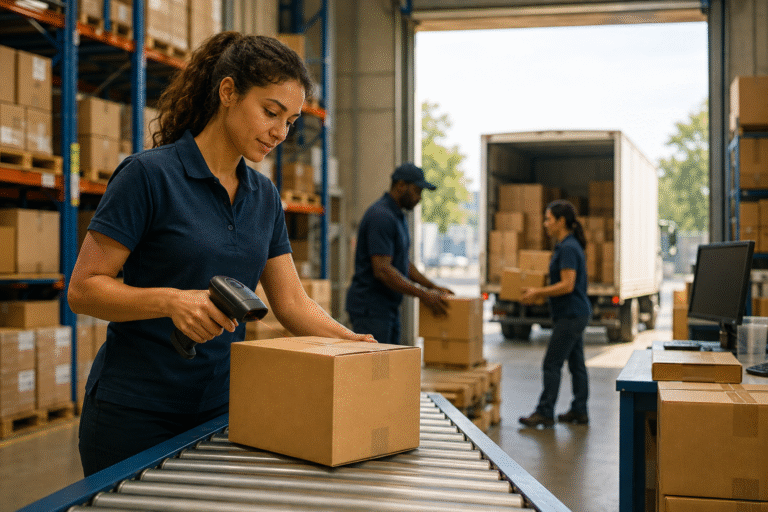
Follow a package from an online order through the warehouse and distribution system until it reaches the customer’s door.
You select a product online, press the “Buy” button, and receive a confirmation message. A few days later, a package appears at your door. The transaction seems simple, but behind it is a complex worldwide network of retailers, warehouses, computers, carriers, and delivery workers.
A package may travel hundreds or even thousands of kilometers before reaching its recipient. Along the way, people and machines must repeatedly check its identity, location, and destination. One incorrect label or delayed shipment can send it to the wrong city. How does this complicated system deliver millions of packages every day?
The Order Begins Its Journey
The journey starts when a retailer receives your order. An inventory system checks whether the merchandise is available and identifies the warehouse where it is stored. Large retailers often operate several warehouses, so the product may not be in the building nearest to you.
The system also verifies your payment and delivery address. If the information is valid, it authorizes the transaction and sends instructions to the warehouse. The customer then receives a confirmation message and an estimated delivery date.
This process usually takes only a few seconds. However, several operations have already occurred. The retailer has accepted the payment, updated its inventory, created an order number, and selected a warehouse. Without an efficient computer system, completing these tasks for thousands of customers would require an enormous workforce.
Inside the Warehouse
A modern warehouse may contain millions of individual items. Shelves can be several stories high, and similar products may be stored in completely different areas. Every product therefore has a special code connected to its location.
When an order arrives, a worker receives an electronic assignment. A handheld device shows which merchandise to collect and the most efficient route through the warehouse. In some facilities, robots carry shelves to packing stations. In others, workers walk long distances each day while collecting products.
At the packing station, another worker verifies that the correct item has been selected. The worker chooses a suitable box and adds protective material when necessary. Using a box that is too large wastes space, while a weak box may allow the product to be damaged.
The package is then weighed and sealed. A shipping label displays its destination and tracking number. An invoice or receipt may be placed inside, although many retailers now provide these documents electronically.
Joining a Larger Shipment
Your package does not usually travel alone. It joins hundreds or thousands of other boxes in a larger shipment. Workers load the packages onto a truck, which carries them to a regional distribution center.
At the center, packages move quickly along conveyor belts. Machines scan their labels and sort them according to destination. A package traveling to a nearby town may leave within a few hours. One going across the country may be transferred to another truck, a train, or an airplane.
Carriers try to maximize the amount of merchandise transported in each vehicle. A half-empty truck is inefficient because it consumes fuel while carrying less cargo. Careful scheduling also matters. If one truck arrives late, packages may miss their next connection, causing delays throughout the distribution network.
Crossing International Borders
International deliveries have an additional stage. Before entering another country, a package may need to be inspected by customs authorities. Officials check what it contains, where it came from, and whether the goods are permitted.
The seller must provide accurate documentation describing the product and its value. Some merchandise may require a special certificate. Other goods, such as dangerous chemicals or certain foods, may be prohibited.
The purchaser may also have to pay an import tax before receiving the package. Missing or incorrect documentation can cause a shipment to remain at a terminal for several days. This is why international retailers must understand the regulations of every country where they operate.
The Final Delivery
Eventually, the package reaches a local delivery center. Workers organize the boxes into routes, and each driver receives a vehicle full of deliveries. This final stage is sometimes called “the last mile.”
The last mile is often the most expensive and difficult part of the journey. A large truck can carry hundreds of packages between two distribution centers, but a local driver must visit many separate addresses. Traffic, bad weather, road construction, and urgent requests can reduce productivity.
Apartment buildings create additional challenges. The recipient may not be at home, or the driver may be unable to enter the building. Some carriers use secure delivery lockers to solve this problem. Customers receive a code and can obtain their packages at a convenient time.
Throughout the journey, each scan updates the tracking information. This allows the retailer, carrier, and customer to follow the package’s progress.
When Something Goes Wrong
Most packages arrive safely, but problems sometimes occur. Merchandise can be damaged, lost, or delivered to the wrong address. A seller may also send the wrong product.
When this happens, the customer usually contacts the retailer and provides the order number. The retailer may request feedback or ask for a photograph showing the damage. Depending on its return policy, it may offer a refund or send a replacement. A warranty may cover problems discovered after the product has been used.
Returns create another journey through the distribution system. The product must be transported, inspected, and either returned to inventory, repaired, recycled, or disposed of. This process costs money and can have a significant environmental impact.
The Network Behind the Box
Online shopping can make distance almost invisible. A product stored in another city—or another country—can reach your home with only a few clicks. Yet the convenience depends on carefully coordinated work at every stage.
The next time a cardboard box appears at your door, look at it differently. It represents computer systems, warehouse assignments, shipping documents, transportation schedules, customs inspections, and a driver’s final route. What seems like a simple delivery is actually the final result of a remarkable worldwide operation.
Take a moment to think about what you read.