Professional Graded Reading Level 1
Krakatoa: The Loudest Sound Ever Heard
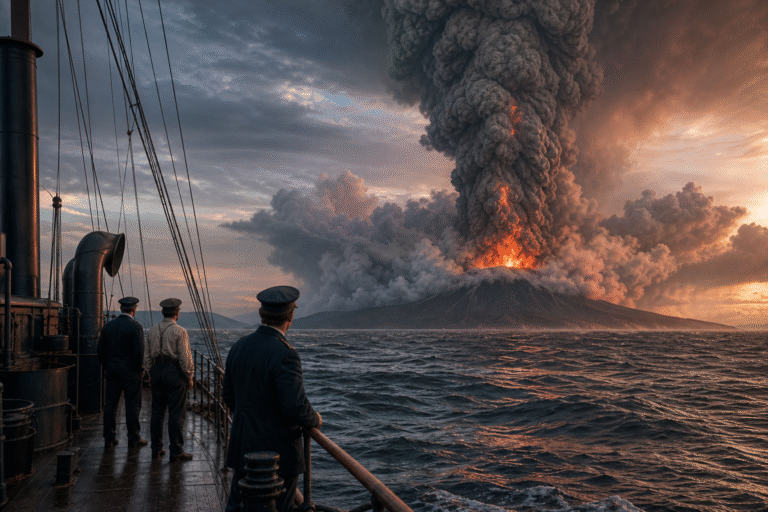
A silent island explodes
An Island Begins to Wake
In 1883, Krakatoa was a volcanic island in the narrow sea passage between the Indonesian islands of Java and Sumatra. The region contained busy shipping routes and many coastal communities. Although the island was not home to a large population, hundreds of thousands of people lived on the nearby coasts.
Krakatoa had been quiet for many years. Then, in May 1883, a ship passing the island reported a high cloud of ash. During the following months, smoke, dust, and hot material continued to rise from the volcano. Explosions could be heard across the surrounding area.
Some people travelled by boat to watch the activity. The sight was impressive, and many observers did not realize how dangerous the situation was. The early explosions were only the beginning.
The Final Explosion
The eruption became much more powerful on August 26. Huge clouds rose above the island, and explosions continued throughout the day and night.
On the morning of August 27, Krakatoa produced four enormous explosions. The last and most powerful one occurred shortly after ten o’clock. It destroyed much of the island and sent a huge amount of rock, gas, and ash high into the atmosphere.
The sound was heard thousands of kilometers away. People on distant islands thought that they could hear heavy guns. Sailors far out at sea also reported the noise. The final explosion is often described as the loudest sound in recorded history.
Near Krakatoa, the pressure from the explosion was extremely powerful. It could damage human ears and shake buildings. The pressure wave travelled through the atmosphere and continued around the planet. Scientific instruments in different countries recorded it several times as it circled Earth.
However, the sound was not the eruption’s most deadly effect.
The Waves That Struck the Coast
As Krakatoa exploded and part of the island collapsed, it moved an enormous amount of seawater. This created a series of tsunamis—large waves caused by a sudden movement of water.
The waves travelled rapidly toward Java and Sumatra. In some places, they reached a height of approximately 40 meters. Coastal residents had very little time to escape. The water destroyed houses, ports, trees, roads, and entire communities.
More than 36,000 people died as a result of the eruption, and the great majority were killed by the tsunamis. Hundreds of towns and villages were damaged or completely destroyed. Boats were carried inland, and large pieces of material from the volcano were thrown across the surrounding sea.
The disaster demonstrated that an island volcano could create danger far beyond the volcano itself.
Darkness in the Middle of the Day
The eruption sent ash tens of kilometers into the sky. Thick clouds covered a vast area and blocked the sunlight. Communities near Krakatoa remained in darkness for more than two days.
Hot clouds of gas, ash, and broken rock also moved rapidly away from the volcano. These flows could destroy almost everything in their path. Some travelled over the surface of the sea and reached nearby coastal areas.
Ash fell on ships hundreds of kilometers away. Sailors had difficulty seeing, breathing, and keeping their vessels under control. The sea was covered with floating volcanic rock, which made travel even more difficult.
When the eruption ended, most of the original island had disappeared. Where solid land had once stood, there was now a large volcanic hole beneath the sea.
Effects Around the World
The effects of Krakatoa did not remain in Indonesia. Fine material from the eruption entered the upper atmosphere and travelled around the world.
For months, people in many countries reported unusually bright red and orange sunsets. In some cities, the sky looked so much like a distant fire that emergency workers prepared to respond. Rings of colored light also appeared around the Sun and Moon.
The material in the atmosphere reduced the amount of sunlight reaching Earth’s surface. Average global temperatures fell slightly during the following year and did not immediately return to their previous level.
Krakatoa also became an important event for international science. Weather stations in many countries had recently begun using similar instruments and recording methods. Researchers compared changes in air pressure, unusual skies, sea movements, and weather conditions. The disaster showed them that one natural event could be measured across the entire world.
The Child of Krakatoa
The story of Krakatoa did not end in 1883. During the 1920s, new volcanic material began to rise from the sea inside the area created by the earlier collapse. Over time, it formed a new island.
The island was named Anak Krakatau, meaning “Child of Krakatoa.” It continued to grow and remained active. In December 2018, part of it collapsed during an eruption and produced another deadly tsunami along nearby coasts.
Today, scientists closely observe the volcano and monitor changes in its activity. Warning systems can provide people with more information than they had in 1883, although volcanic islands remain difficult to predict.
A Disaster Heard Around the Planet
The eruption of Krakatoa was not only an Indonesian disaster. Its sound crossed oceans, its pressure wave circled the planet, and its ash changed skies around the world. Its tsunamis showed how quickly a local event could become a regional emergency.
The people living near Krakatoa had no modern warning network and little understanding of the danger. Their experience helped later generations recognize the connections between volcanic eruptions, collapsing land, and destructive sea waves.
Krakatoa reminds us that Earth is an active planet. An island may appear small on a world map, but the forces beneath it can affect communities thousands of kilometers away.
Take a moment to think about what you read.
Check your understanding
Check Your Understanding
Question 1 of 10