Professional Graded Reading Level 2
The Strange Theft of the Mona Lisa
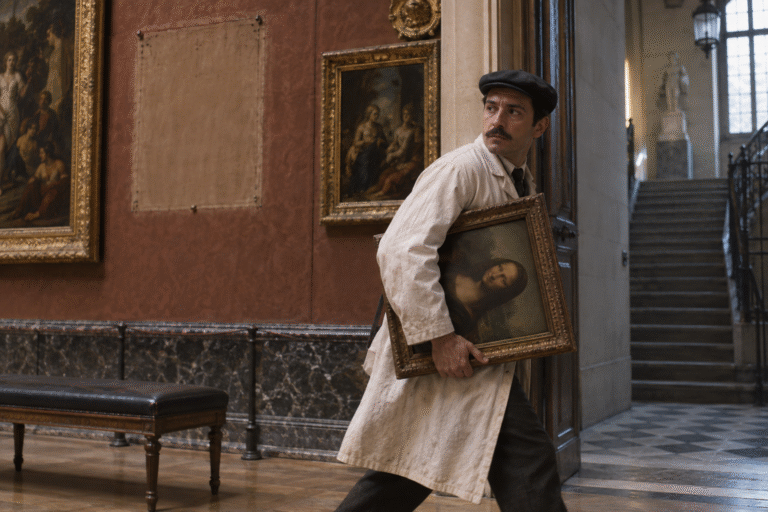
A former museum worker stole the Mona Lisa and accidentally helped make it the most famous painting in the world.
A Famous Face
Today, the Mona Lisa may be the most famous painting in the world. Millions of people visit the Louvre Museum in Paris each year, and many come mainly to see her mysterious smile.
Leonardo da Vinci painted the portrait in Italy during the early sixteenth century. The woman is generally identified as Lisa Gherardini, the wife of a businessman from Florence. Leonardo later brought the painting to France, where it became part of the French royal collection. After the French Revolution, it entered the Louvre.
The painting was already respected by artists and experts, but it did not yet have its present worldwide popularity. That changed in 1911—not because of a new artistic discovery, but because somebody stole it.
A Worker Who Knew the Museum
Vincenzo Peruggia was an Italian worker who had previously completed assignments at the Louvre. His work included placing glass in front of paintings to protect them. As a result, he understood the building and knew how some artworks were secured.
On Monday, August 21, 1911, the Louvre was closed to the public. Museum workers, however, could still enter. Peruggia wore a white work coat similar to those used by Louvre employees. Inside the museum, he removed the Mona Lisa from the wall and carried it to a quiet stairway.
The complete object was too large to carry easily. The painting itself was made on a thin piece of wood, but it was held inside a much heavier frame and protective case. Peruggia separated the portrait from these materials.
He then hid the relatively small painting beneath his clothing and attempted to leave through a service exit. For a short time, he had difficulty opening a locked door. However, he eventually escaped from the museum with the painting.
The theft appeared surprisingly simple.
Nobody Notices
The empty space on the wall did not cause an immediate alarm. Museum staff commonly removed paintings for inspection or photography, so workers assumed that another department had taken it.
The following day, an artist arrived at the Louvre to study and copy the Mona Lisa. He asked a guard when the painting would be returned. The guard began making inquiries and discovered that neither the photography department nor any other authorized worker had it.
The museum was closed, and officials conducted a major search. They examined galleries, storage areas, offices, exits, and cabinets. Eventually, the missing frame and protective materials were found in a stairway. It became clear that the painting had been stolen.
The news quickly spread through the media. Newspapers printed images of the empty space and asked how such an important work could disappear from a major national museum.
An Investigation Without Results
The French authorities began an enormous investigation. They questioned museum employees and examined identification records. Border officials were notified, and ships and trains were inspected. A substantial reward was offered for the painting’s safe return.
Police even questioned the poet Guillaume Apollinaire and the young artist Pablo Picasso. They had connections to a man who had previously taken small objects from the Louvre. Both men were released because there was no evidence connecting them to the missing painting.
Peruggia was also interviewed because he had worked at the museum. He told the police that he had learned about the theft from newspapers. Investigators accepted his explanation and did not conduct a complete inspection of his room.
The Mona Lisa was hidden there.
For more than two years, Peruggia kept the painting inside his small apartment in Paris. At different times, he reportedly stored it in a wooden container or beneath other materials. The police continued their search, but no reliable information led them to it.
The Empty Space Becomes an Attraction
The theft had an unexpected effect. Large crowds visited the Louvre simply to look at the empty space where the Mona Lisa had hung. Newspapers throughout Europe and North America published reports, predictions, and theories about the crime.
Copies of the portrait appeared everywhere. People who had never studied Leonardo da Vinci now recognized the woman’s face. The missing painting became more popular than it had ever been while hanging safely inside the museum.
The mystery created its own form of publicity. Was the thief an international art collector? Had someone ordered the crime? Had the painting been destroyed? Without valid evidence, almost any explanation seemed possible.
An Offer in Florence
In late 1913, Peruggia returned to Italy with the painting. He contacted Alfredo Geri, an art dealer in Florence, and used a false name. He claimed that he wanted to return the Mona Lisa to Italy.
Geri arranged a meeting and invited Giovanni Poggi, the director of an important Florence museum. The two experts inspected the painting. An identification number on the back helped them verify that it was the missing original.
They told Peruggia that the painting needed further inspection and then notified the authorities. Police arrested him at his hotel.
Peruggia said he had acted out of loyalty to Italy. He believed that Napoleon had taken the Mona Lisa from his country and that it should be returned. In fact, Leonardo had brought the painting to France centuries earlier, and the French king had obtained it legally.
Some people questioned whether Peruggia’s stated purpose was completely honest. He had discussed payment with the dealer, so financial benefit may also have influenced him.
The Painting Returns
The recovered Mona Lisa was displayed in Florence and Rome before being returned to France. On January 4, 1914, it was placed back in the Louvre. Peruggia received a relatively short prison sentence.
The museum improved its security, and the painting later received increasingly strong protection. Today it is displayed behind special glass, with controlled temperature and strict safety systems.
The theft permanently changed the Mona Lisa’s position in popular culture. Leonardo’s artistic expertise created the painting, but its disappearance made its image familiar worldwide.
Vincenzo Peruggia intended to remove the portrait from the Louvre. Instead, his strange crime helped transform it into the museum’s most famous attraction.
Take a moment to think about what you read.
Vocabulary Help
Gloss
- theft — the crime of taking something that belongs to another person
- artistic — relating to art or the creation of art
- protective — intended to keep someone or something safe
- stairway — a set of stairs connecting one level of a building to another
- collector — a person who gathers and keeps valuable or interesting objects
- disappearance — the act of becoming impossible to find or see
- loyalty — strong support for a person, group, or country
- publicity — attention given to someone or something by newspapers, television, or other media
- reportedly — according to what people or news organizations have said
- thief — a person who steals something