Louis Pasteur
How We Found Germs
Two hundred years ago, people often got sick and died, but no one really knew the reason. Some believed bad air caused illness, while others blamed bad luck. Then a scientist named Louis Pasteur discovered the real cause.
Louis Pasteur was born in France in 1822. His father worked as a leather maker, and the family did not have much money. Louis was very smart and loved to learn. He went to university and became a scientist.
At first, Pasteur studied rocks and other materials. Later, some people who made wine for a living came to him with a problem. Sometimes their wine spoiled, and they did not know why. They asked Pasteur for help.
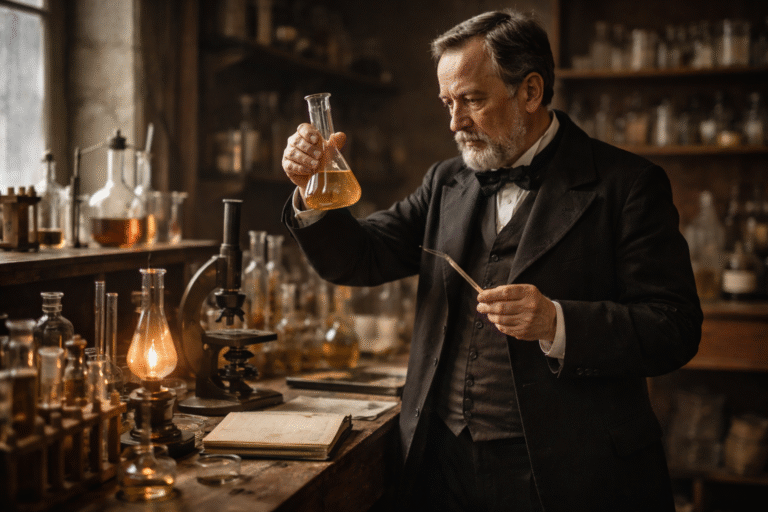
Pasteur carefully examined the wine under a microscope, a tool that magnified tiny details. When he looked at the spoiled wine, he saw something strange. There were tiny living things in the wine, too small to see without the microscope.
Pasteur realized that these tiny living things were causing the wine to spoil. He called them germs. He discovered that heating the wine enough would kill the germs, so the wine stayed good. People still use this method today, called pasteurization, named after Pasteur.
Pasteur kept looking for other problems to solve. He noticed that milk also spoiled quickly and found germs in milk, too. By heating the milk, he could kill the germs and make it safe to drink. This saved many lives, especially young children.
Then Pasteur had an even bigger idea: maybe germs also made people sick. Most doctors at the time did not believe this and thought disease came from bad air or problems inside the body. But Pasteur was sure he was right.
He started studying diseases in animals. He examined dying sheep and found germs in them. He grew these germs in his lab and heated them slightly. This weakened, but did not kill them.
Next, Pasteur did something very brave. He gave the weak germs to healthy sheep. The sheep became a little sick but soon recovered. After that, they never got the disease again because their bodies had learned to fight it. Pasteur had created the first modern vaccine.
This was a huge discovery. It showed that people could be protected from disease before getting sick. By giving them a weak form of the germs, their bodies would learn to fight them. Then, if the real disease appeared, their bodies would be ready.
Pasteur worked on vaccines for many diseases, but his most famous work was on rabies. Rabies is spread by the bite of a sick animal. People who got rabies always died because there was no cure.
Pasteur developed a rabies vaccine, but he had tested it only on animals. He did not know if it would work for people. One day, a mother came to him because her young son had been bitten by a sick dog and was going to die from rabies.
Pasteur faced a difficult decision. The vaccine might not work on humans and could even harm the boy. But if he did nothing, the boy would certainly die. Pasteur decided to try. He gave the boy the vaccine every day for ten days. The boy survived. The vaccine worked.
After this, people from all over the world came to get the rabies vaccine. Pasteur opened a special building for this work, which is still in Paris today. It is called the Pasteur Institute.
Pasteur showed the world that tiny germs cause illness and that science can help us fight disease. Because of his work, doctors started washing their hands and cleaning their tools. This simple change saved millions of lives.
Louis Pasteur died in 1895 at the age of 72. His work changed medicine forever. Today, we vaccinate children to protect them from many diseases, pasteurize milk and other foods to kill germs, and know that washing our hands helps stop the spread of illness. All of this began with one man and his microscope.
Take a moment to think about what you read.
Check your understanding
- What did many people believe caused illness before Louis Pasteur’s discoveries?
A. Tiny living organisms
B. Bad air or bad luck
C. Poor diet alone
D. Lack of exercise - What tool did Pasteur use to see the tiny living things in spoiled wine?
A. A telescope
B. A microscope
C. A magnifying glass
D. A camera - What is the process called in which heating kills germs in food and drink?
A. Fermentation
B. Vaccination
C. Pasteurization
D. Sterilization - How did Pasteur create the first modern vaccine?
A. By injecting strong germs into animals
B. By removing germs completely
C. By exposing animals to cold temperatures
D. By using weakened germs to train the body - Which disease was Pasteur most famous for developing a vaccine against?
A. Cholera
B. Tuberculosis
C. Rabies
D. Smallpox - What immediate result followed Pasteur’s rabies vaccine experiment on the boy?
A. The boy became seriously ill
B. The boy died shortly afterward
C. The vaccine was banned
D. The boy survived
Show answers
Answers:
- b
- b
- c
- d
- c
- d