The Year Without a Summer
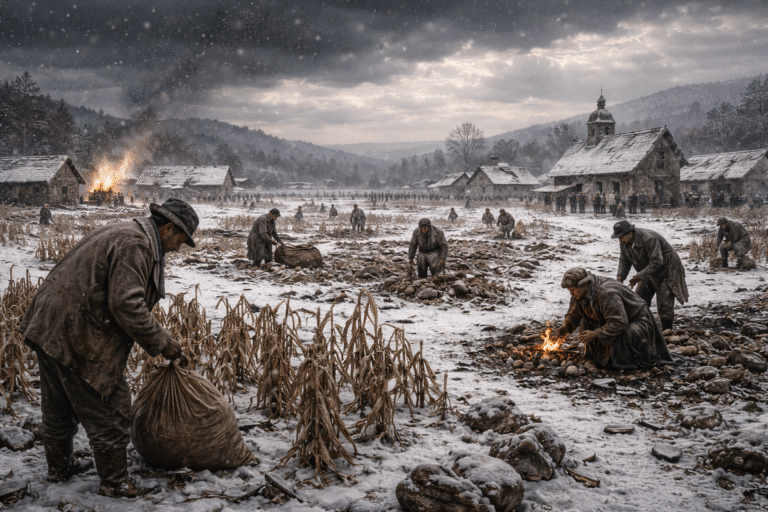
A summer of snow, hunger, and darkness
The year 1816 is called “the year without a summer.” It stands out as one of the strangest and hardest years in recent history. In Europe and North America, summer never arrived. The weather stayed cold and gloomy. Snow fell in June and July. Crops failed in the fields. People went hungry, and thousands lost their lives. All this suffering was caused by a volcano far away on the other side of the world.
In April 1815, Mount Tambora in Indonesia erupted. It was the biggest volcanic explosion ever recorded. The mountain broke apart with huge force, and the sound traveled for thousands of miles. Hot ash and rock blasted into the sky. Rivers of lava flowed down the mountain, wiping out entire villages. More than seventy thousand people died.
But the eruption did more than just destroy the land nearby. It sent huge amounts of ash and dust high into the atmosphere. This cloud spread all over the world, blocking some sunlight and heat from reaching the ground. As a result, the planet became cooler.
At first, people did not notice much difference. The winter of 1815-1816 was cold, but nothing out of the ordinary. When spring arrived, farmers planted their seeds as usual. But then things changed. The weather stayed cold. Dark clouds filled the sky day after day. The sun looked odd and weak, with dim, reddish light.
In May 1816, frost killed many young plants in New England. Farmers tried planting again. Then in June, snow fell across New York and New England. People woke up to find snow on the ground in the middle of summer. The few crops that survived froze and died. In July, lakes and rivers in Pennsylvania had ice. In August, more frost came and destroyed what little remained.
Europe had an even harder time than America. The summer of 1816 was cold and wet across the continent. It rained nearly every day. Crops failed everywhere, and food prices kept rising. Many poor people could not afford bread. In some places, people ate grass, cats, and dogs because they had nothing else. Riots broke out as hungry crowds demanded food.
In Switzerland, the cold and wet weather was so bad that many farmers lost everything. Some families chose to leave Europe and move to America, hoping for a better life. In Ireland, the potato crop failed, and thousands starved. Disease spread among the weak and hungry.
Unusual things happened in the sky. Dust in the air made sunsets bright red and orange. In some places, snow was brown or yellow because of volcanic ash. Birds disappeared or behaved oddly. Animals came down from the mountains looking for food.
Writers and artists also noticed the strange weather. That summer, the well-known English writer Mary Shelley stayed at a house by a lake in Switzerland. The weather was so cold and dark that she and her friends stayed indoors for days. To pass the time, they wrote scary stories. During those gloomy days, Mary Shelley created her most famous book, “Frankenstein.”
No one in Europe or America knew what caused the strange weather. News about Mount Tambora had not reached them. People were confused and scared. Some thought God was angry. Others believed the world was ending. A few scientists tried to study the odd conditions, but they could not explain what was happening.
It was only later that people understood the link between the volcano in Indonesia and the cold summer in Europe and America. They learned that volcanoes could change the weather all over the world. The ash and dust from Mount Tambora stayed in the air for more than a year before finally settling back to Earth.
By 1817, the weather returned to normal and farmers could grow crops again. Still, people remembered the year without a summer, which made them more aware of how fragile the environment can be. The disaster showed early on that events far away can have effects around the world. This lesson is still important today, as we face challenges from climate change and volcanic eruptions. It reminds us how much we depend on stable weather for survival.
Take a moment to think about what you read.
Check your understanding
- Why is the year 1816 known as “the year without a summer”?
A. A long drought destroyed crops
B. War prevented farming
C. Cold weather continued through the summer months
D. A disease spread among farmers - What natural event caused the unusual global weather in 1816?
A. An asteroid impact
B. A massive volcanic eruption
C. A shift in ocean currents
D. A solar storm - Where did the volcanic eruption that caused the climate change occur?
A. Iceland
B. Italy
C. Japan
D. Indonesia - How did volcanic ash affect the Earth’s climate after the eruption?
A. It increased rainfall worldwide
B. It blocked sunlight and cooled the planet
C. It raised ocean temperatures
D. It caused stronger winds - What happened to crops in Europe and North America during 1816?
A. They grew later than usual but survived
B. They were damaged mainly by insects
C. They failed because of frost and cold weather
D. They were destroyed by floods only - What famous novel was written during the cold summer of 1816?
A. Dracula
B. Wuthering Heights
C. The Time Machine
D. Frankenstein
Show answers
Answers:
- c
- b
- d
- b
- c
- d