The Disappearing Lighthouse Keepers
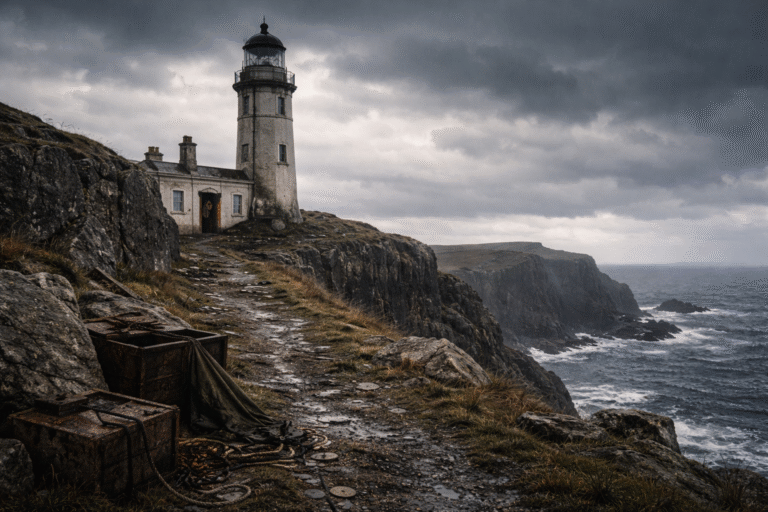
A remote island, a darkened light, and three missing men.
The Flannan Isles are a group of small islands far off the coast of Scotland. No one lives there. The islands are nothing but rock and grass, and the sea around them is cold and dangerous. The air is thick with the smell of salt, and the wind carries a biting chill that pierces through to the bone. In 1899, the government built a lighthouse on the largest island to help ships find their way safely through the dark waters.
Three men worked at the lighthouse. Their job was to keep the light burning every night so that ships would not hit the rocks. The three keepers were James Ducat, Thomas Marshall, and Donald MacArthur. Each brought his own personality to the isolated island. James Ducat, a father of four and an avid reader, often shared tales from his favorite books with his colleagues. Thomas Marshall, although reserved, had a flair for music and would often hum melodies to break the monotony of long shifts. The youngest, Donald MacArthur, was known for his mischievous jokes and love for sketching the dramatic seascapes around them. They lived at the lighthouse together, taking turns to watch the light and do the daily work.
On December 15, 1900, the ship Archtor passed by the islands. The captain noticed something strange. The lighthouse was dark. There was no light shining to warn ships of danger. He wrote this in his ship’s record book, but he could not stop because the weather was too bad.
A few days later, on December 26, a supply boat arrived at the island. The boat came every few weeks to bring food and other things the keepers needed. Joseph Moore, who worked on the supply boat, went up to the lighthouse to greet the men. But no one came out to meet him. The island was completely silent.
Moore walked up to the lighthouse door. It was closed but not locked. He opened it and went inside, calling out to the keepers. No one answered. The lighthouse was empty.
Inside, everything looked normal at first. The beds were made. The clock on the wall had stopped. In the kitchen, there were plates and cups on the table, as if the men had been eating a meal. But the food was old and cold. One chair had fallen over and was lying on the floor.
Moore was scared but kept searching. He checked the record book where the keepers wrote daily notes. The last entry was from December 15, the same day the Archtor’s captain noticed the light was out. Thomas Marshall wrote about terrible storms and strong winds. This seemed odd, though, because a steamer that passed the lighthouse around midnight on December 15 also saw that the light was off but did not mention any storms. To add to the confusion, a second ship, the SS Fairwind, recorded fairly calm weather on the same night, highlighting the inconsistency in weather accounts. No one reported this until the Lighthouse Tender Hesperus visited on December 26.
Outside the lighthouse, Moore found more things that seemed out of place. Two of the three waterproof coats that the keepers wore were missing. But the third coat was still hanging on its hook. This meant that one man had gone outside without protection from the rain and cold. What emergency could yank a keeper outside coatless on a winter night?
At the edge of the island, Moore saw that one of the large boxes where they kept rope and tools had been damaged. Heavy stones had been moved from their usual place. It looked like a huge wave had hit the island, but the box was more than thirty meters above the level of the sea. Could a wave really reach that high?
The three men were never found. No bodies were discovered on the island or in the sea. It was as if they had simply disappeared into the air.
Many people tried to explain what happened. One evidence-based theory is that a giant wave came and swept all three men into the ocean. But this raises questions: why were they all outside at the same time, and why did one leave without his coat? A speculative theory suggests that the men fought and killed each other, then disposed of the bodies in the sea. However, there was no evidence of a struggle or murder at the lighthouse.
Some people shared stories about ghosts or sea monsters, but most did not believe them. The most accepted evidence-based idea is that two men went outside during a storm to check damaged equipment, perhaps for urgent repairs. The theory speculates that the third man saw his coworkers in danger and ran out without his coat. Evidence like the moved stones and broken storage box suggests a storm occurred. This explanation aligns with the real challenges the keepers faced and explains the missing coats. Still, there are significant questions, like whether a wave could reach high enough to take all three men and why they would all leave the lighthouse at once. While the storm-and-wave theory has the most support, some details remain unexplained, leaving the mystery not fully solved.
But no one knows for sure. The lighthouse still stands on the island today, though it now operates automatically and requires no keepers. The mystery of what happened to James Ducat, Thomas Marshall, and Donald MacArthur remains unsolved.
Take a moment to think about what you read.
Check your understanding
- Where are the Flannan Isles located?
A. Off the coast of Ireland
B. In the North Sea near Norway
C. Off the coast of Scotland
D. Near the Faroe Islands - How many lighthouse keepers worked on the Flannan Isles lighthouse?
A. Two
B. Four
C. Five
D. Three - On what date was the lighthouse first noticed to be dark?
A. December 26, 1900
B. December 10, 1900
C. December 15, 1900
D. December 1, 1900 - What unusual detail was found inside the lighthouse kitchen?
A. Food was still cooking on the stove
B. Plates and cups were set out with cold food
C. All furniture was missing
D. The walls were damaged by water - What item suggested that one keeper went outside without protection?
A. A missing lantern
B. A broken door
C. A torn rope
D. A coat still hanging inside - Which explanation is most widely accepted by investigators?
A. The men escaped to another island
B. They were taken by sea creatures
C. A large wave swept them into the ocean
D. They were kidnapped by pirates
Show answers
Answers:
- c
- d
- c
- b
- d
- c