The Lost Giants
Why Big Animals Disappeared
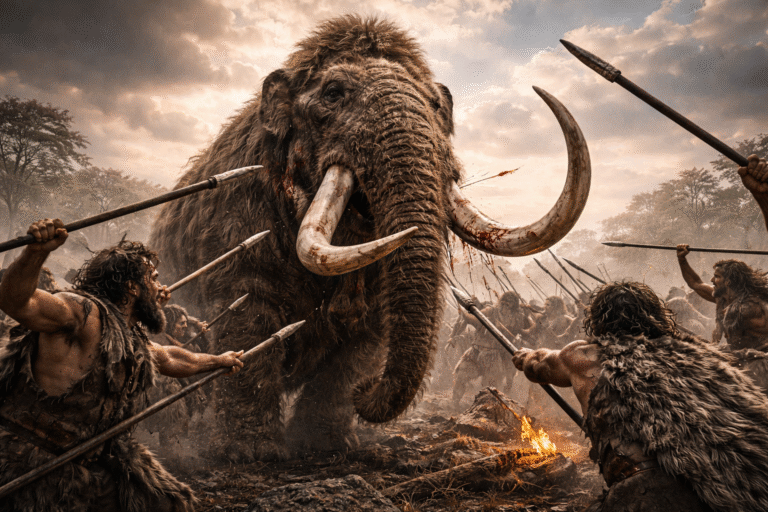
How Earth lost its giants (except in Africa)
Africa is still home to elephants, rhinoceroses, lions, and giraffes. These giants roam the plains and forests. But long ago, other continents had their own big animals. North America had mammoths with huge curved tusks, sabertooth cats with long fangs, and ground sloths as large as elephants. In Australia, there were giant wombats the size of cars, marsupial lions, and kangaroos that stood three meters tall. Between 50,000 and 10,000 years ago, these animals vanished. Now, only Africa still has its giants. What caused this? Why did big animals disappear everywhere except Africa? Scientists have wondered about this for years, and the answer is complicated.
One idea is that humans were to blame. When people first arrived in North America about 15,000 years ago, many large animal species were present. Within 2,000 years, approximately 70% of North America’s megafauna had vanished. A similar pattern occurred in Australia. Humans arrived there about 50,000 years ago, and within a few thousand years, 80% of its giant creatures were gone. This pattern seems unlikely to be a coincidence.
Early humans were skilled hunters who used spears, fire, and teamwork to hunt even the biggest animals. For these large animals, humans were a new kind of predator. Since they had not evolved alongside people, they did not see humans as a threat and did not develop ways to defend themselves. An archaeological discovery at a site in North America provides a vivid example: a cache of sharpened spear points found alongside mammoth rib bones tells the story of a dramatic hunting scene. The mammoth, unaware of the threat, fell to the collaborative efforts of human hunters, highlighting its vulnerability.
Also, these animals had slow reproductive rates, with only one or two young every few years, so their populations could not recover quickly from hunting. According to this theory, the steady pressure from human hunting over many generations caused populations to collapse and eventually led to extinction. Some scientists believe that human hunting was the main reason these giants disappeared.
Other scientists think climate change played a big role in these North American extinctions. The Ice Age was ending at this time, and the world was warming up. Glaciers melted, and rain patterns shifted. The plants that big animals ate started to disappear. Mammoths needed a lot of grass and other plants every day, but as the climate changed, their food became scarce. Giant ground sloths lived in certain environments, and when those changed, the sloths had nowhere else to go.
In Australia, the land became drier, lakes dried up, and forests turned into deserts. Cracked mud plains glittered with salt where waterbirds once nested, and the air was filled with the dry, earthy smell of parched soil. The giant wombats and huge kangaroos could not adapt fast enough. Climate change may have weakened and made these animals rare, even before humans arrived.
Disease is another possible reason. When humans entered new areas, they brought animals like dogs with them. People may have unknowingly brought deadly diseases that the giant animals could not fight off, which might have helped cause their extinction. A disease that barely affects a dog could be fatal to a mammoth. We see similar things today—new diseases can devastate isolated groups. Studies of the woolly mammoths on Wrangel Island show they had many harmful genetic mutations because their population was so small, which may have also led to their extinction. This theory is harder to prove since diseases do not leave many signs in old bones, but scientists think it could have mattered.
Most likely, these causes worked together, worsening each other. Climate change first caused food shortages, weakening animal populations, and reducing their numbers. When humans arrived, they hunted these already struggling animals, adding more pressure. At the same time, new diseases brought by people or their animals could have made things even worse for groups already dealing with hunger and hunting. Instead of one single cause, it was the combined effects of climate change, hunting, and disease that slowly pushed giant animals toward extinction. This mix of problems led to a long, slow decline over thousands of years, not a quick disaster.
So why did Africa keep its giants? The answer may lie in time. Humans evolved in Africa. They lived there for hundreds of thousands of years before spreading to other continents. African animals grew up alongside humans. They learned to fear people over many generations. They developed behaviors to avoid hunters. They became faster, smarter, and more careful. When humans reached North America and Australia, it was sudden. The animals there had no time to learn, no generations to develop fear and caution. By the time they understood the danger, it was too late.
Africa also had more diverse environments. When the climate changed, animals could move to different areas. The continent spans 14 distinct ecoregions, providing a vast ecological safety net for migration and adaptation. An elephant could walk from a dry region to one with more water. In Australia, a giant wombat had fewer choices. The whole continent was becoming drier. There was nowhere to go.
The loss of these giant animals changed the world permanently. Without big animals to eat plants and spread seeds, forests and grasslands changed. Rivers also flowed differently because mammoths were no longer there to dig and shape the land. This loss still affects us today. Our world is much emptier than it once was. By understanding why these animals disappeared, we can help protect the giants that are left. Africa’s elephants and rhinos now face dangers from hunting and the loss of their homes. We have a chance to learn from the past and make better choices. The real question is: will we?
Take a moment to think about what you read.
Check your understanding
- Which continent still has many large animals such as elephants and giraffes today?
A. North America
B. Australia
C. Europe
D. Africa - About how long ago did many giant animals disappear from North America and Australia?
A. 1,000–500 years ago
B. 5,000–3,000 years ago
C. 50,000–10,000 years ago
D. 500,000–300,000 years ago - What percentage of North America’s megafauna disappeared within about 2,000 years after humans arrived?
A. About 30%
B. About 50%
C. About 70%
D. About 90% - Why were large animals especially vulnerable to human hunting?
A. They lived only in forests
B. They had slow reproductive rates
C. They could not run fast
D. They lived in small groups - What environmental change reduced food for animals like mammoths?
A. Volcanic eruptions
B. The end of the Ice Age and climate warming
C. Asteroid impacts
D. Rising sea levels flooding grasslands - Why did Africa keep its giant animals while other continents did not?
A. Africa had no climate change
B. Humans never hunted in Africa
C. African animals evolved alongside humans and learned to avoid them
D. African animals reproduced much faster
Show answers
Answers:
- d
- c
- c
- b
- b
- c