Apollo 13
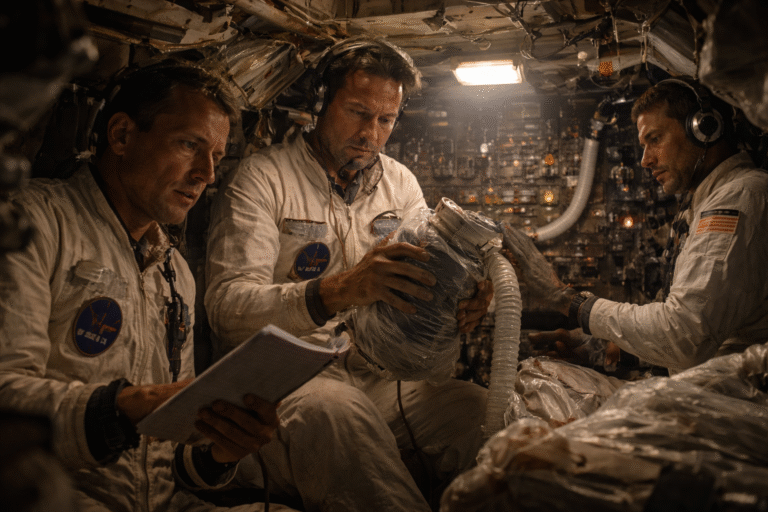
Houston, we’ve had a problem.
On April 11, 1970, three American astronauts, Jim Lovell, Fred Haise, and Jack Swigert, waited inside their spacecraft at Kennedy Space Center in Florida. The heat of the Florida sun seeped through the metal hull, and the air inside the cabin was filled with a mix of anticipation and the smell of machine oil. The steady thrum of the spacecraft’s systems echoed around them, a constant reminder of the technology that would soon catapult them into space. With the roar of engines igniting, Apollo 13 launched into the sky, marking their third mission to land on the moon. It was a smooth launch, and everything felt normal. Apollo 13 was expected to be NASA’s easiest moon mission so far, but it soon turned into the most dramatic rescue in space history.
Trouble started on April 13, two days into the mission. The crew had just finished a TV broadcast showing people on Earth what life was like inside the spacecraft. Most Americans were no longer excited about moon missions, so few watched. People had already seen astronauts walk on the moon twice. But what happened next caught the world’s attention.
At 55 hours and 55 minutes into the flight, the crew heard a loud bang. The spacecraft shook hard, and warning lights flashed. Jack Swigert saw his instruments go wild. He pressed the radio button and said the now-famous words: “Okay, Houston, we’ve had a problem here.” Mission Control asked him to repeat, and Commander Jim Lovell confirmed: “Houston, we’ve had a problem.”
The situation was dire. One of the oxygen tanks in the service module had exploded, tearing a hole in the spacecraft. Oxygen leaked out into space. Without oxygen, the fuel cells that made electricity would fail. Without electricity, there would be no heat, no air, and no way to control the ship. They were 320,000 kilometers from Earth and in grave danger.
The crew gave up on landing on the moon right away. Their only goal was to survive. They decided to use the lunar module, called Aquarius, as a lifeboat. It was meant to support two astronauts on the moon for about 45 hours, but now it had to keep three men alive for four days. Every hour, they lost 5 percent of their power reserves, heightening the urgency of their situation. They shut down every system to save energy. The temperature inside dropped to just above freezing, and condensation formed on the walls. The astronauts wore several layers of clothing but still shivered all the time.
Water became severely rationed. Each astronaut was allowed only 200 milliliters per day, about one glass. As the days passed, their parched throats made their tongues feel like sandpaper, and their voices turned raspy over the headset, a constant reminder of their dire situation. This amount was far below what a human body needs. The men became dangerously dehydrated. Fred Haise developed a kidney infection from lack of water and had a high fever, but there was nothing anyone could do.
Another problem came up: carbon dioxide. The lunar module’s filters were made for two people, not three. Carbon dioxide started to build up to dangerous levels. If it got too high, the astronauts could suffocate. The command module had extra filters, but they were square, while the lunar module needed round ones.
Engineers at Mission Control had to solve a tough problem: how to fit a square filter into a round hole using only what was on the spacecraft. They quickly came up with a homemade adapter using cardboard, plastic bags, tape, and parts of space suits. They sent instructions to the crew, who built it. It worked, and carbon dioxide levels dropped to safe levels. This quick fix saved their lives.
NASA engineers were also concerned about the spacecraft’s path. Would it return to Earth at the right angle? Imagine throwing a stone across a pond. If you angle it just right, it skips across the water. But if the angle is too steep, it plunges straight to the bottom. The same applied to Apollo 13: if the angle was too shallow, they would bounce off the atmosphere and be lost in space. If it was too steep, they would burn up upon entry. The crew had to do a crucial engine burn to fix their course, but they had to do it by hand using the lunar module’s small engine, which was not meant for this job.
Jim Lovell carefully aligned the spacecraft by keeping Earth in the center of the window. At the right moment, they fired the engine. The burn had to last just the right amount of time. When it stopped, they didn’t know right away if it had worked. They would only find out when they got back to Earth. The crew faced one final obstacle. They needed to abandon Aquarius and return to the command module, Odyssey, for reentry. Lovell initiated the sequence to power up Odyssey’s systems, wondering if they would restart after days in the freezing cold of space. Would the parachutes deploy properly? To their relief, everything worked. They separated from Aquarius, leaving behind the small spacecraft that had kept them alive.
As Odyssey plunged into Earth’s atmosphere, friction heated the heat shield to over 2,000 degrees Celsius. Radio contact was lost, as always happens during reentry. Mission Control waited nervously. The usual blackout lasted three minutes. Three minutes went by. Then four. Still no signal, but the parachutes had deployed, and Odyssey splashed down in the Pacific Ocean. Inside Mission Control, engineers cheered, cried, and hugged each other. Around the world, millions felt overwhelming relief. The crew was safe.
People often call Apollo 13 a “successful failure.” The mission didn’t land on the moon, but it showed amazing problem-solving, teamwork, and courage under pressure. Few know that Jim Lovell’s wife lost her wedding ring down the drain the morning of the launch. She thought it was a bad sign. After the crew’s safe return, the ring was found. Maybe it was a sign, but one that ended with recovery and reunion, not tragedy.
The Apollo 13 story is still one of the most inspiring moments in space history. It’s not inspiring because the mission went as planned, but because it showed what people can do when things go wrong.
Take a moment to think about what you read.
Check your understanding
- When did Apollo 13 launch from Kennedy Space Center?
A. April 11, 1969
B. April 13, 1970
C. April 11, 1970
D. April 15, 1970 - What caused the emergency on Apollo 13?
A. A computer failure
B. An oxygen tank explosion
C. A fire in the command module
D. A collision with space debris - What famous message did the crew send to Mission Control after the explosion?
A. “We are aborting the mission.”
B. “The oxygen tank is leaking.”
C. “Houston, we have landed.”
D. “Houston, we’ve had a problem.” - Why did the crew use the lunar module Aquarius as a lifeboat?
A. The command module was too small
B. Aquarius had extra fuel
C. The command module had lost power and oxygen
D. Aquarius was designed for emergency landings - What serious health problem did Fred Haise develop during the mission?
A. A broken bone
B. Heat exhaustion
C. A kidney infection
D. Carbon dioxide poisoning - What happened at the end of the Apollo 13 mission?
A. The spacecraft landed on the moon
B. The crew returned safely to Earth
C. The spacecraft burned up in the atmosphere
D. The crew remained in orbit
Show answers
Answers:
- c
- b
- d
- c
- c
- b