Are Octopuses Aliens?
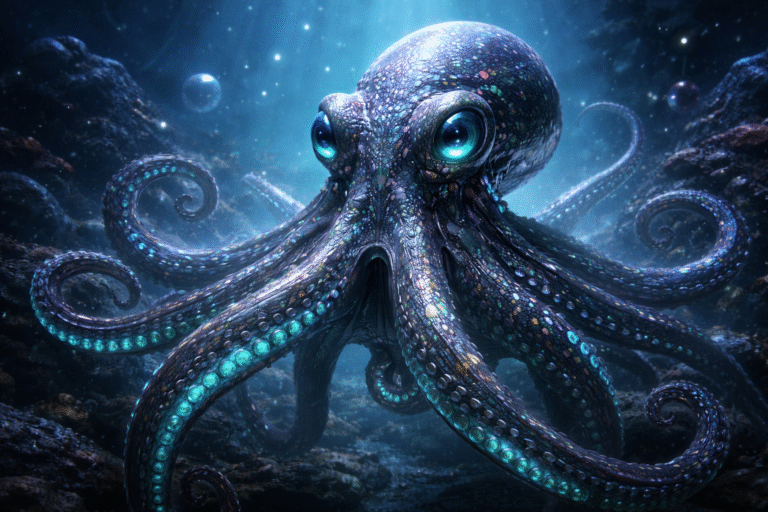
8 arms, 3 hearts and blue blood
Seeing an octopus for the first time might make you think it comes from another planet. With eight arms covered in suckers, three hearts pumping blue blood, and big, watchful eyes, it really stands out. Marine biologist Roger Hanlon notes that octopuses can change color in less than a second to blend in with rocks or coral. Some can squeeze their whole bodies through a hole as small as a coin, even if they are as big as a person. Picture an umbrella folding itself through a mail slot; this is how an octopus maneuvers its body through incredibly tight spaces. They seem so strange and different from us that people sometimes joke that they must be aliens. But are they really that different, or do they just show us another way life can develop?
The octopus brain is impressive. These animals are very smart, maybe the most intelligent creatures without a backbone. They can solve puzzles, open jars to get food, and remember solutions for months. In labs, octopuses have learned to recognize individual human faces and treat people they like differently from those they do not. Some even squirt water at researchers they find annoying. This kind of intelligence is rare in the ocean. Most sea animals act on instinct, doing what their parents did. Octopuses are different because they learn, plan, and make choices.
What makes octopus intelligence even more unusual is how different their brains are from ours. Humans and other mammals have brains in their heads, where all thinking happens. An octopus spreads its intelligence throughout its body. About two-thirds of its brain cells are in its eight arms, not its head. Each arm can act on its own. For example, one arm might look for food under a rock while the other explores elsewhere. The arms do not need to check with the main brain first. They work on their own and only report back when they find something important. Imagine if your hands could think for themselves—that is what life is like for an octopus.
Octopus blood is blue because it uses copper to carry oxygen, while human blood uses iron, which makes it red. Copper works better in cold, oxygen-poor ocean water. Octopuses developed this way of carrying oxygen millions of years ago, long before humans existed. They also have three hearts. Two pump blood to the gills to get oxygen from water, and the third sends blood to the rest of the body. When an octopus swims, its main heart stops beating, so they usually crawl along the ocean floor instead of swimming. Swimming makes them tired.
One of the most amazing things about octopuses is their ability to change color. They have special skin cells called chromatophores that contain different-colored pigments. Octopuses can quickly expand or shrink these cells to make any pattern they want. They can look like sand, rocks, coral, or seaweed. Some species can even make moving patterns, with waves of color flowing over their skin. They use this skill to hide from predators, hunt prey, and talk to other octopuses. Scientists also think these color changes might show the octopus’s mood or thoughts, like a visual language we do not yet understand.
Even with all their intelligence and special abilities, octopuses do not live long. Most species live only one or two years, and even the largest rarely live past five. They reproduce once and then die. The mother lays thousands of eggs and guards them closely, not eating for months until they hatch. After the babies are born, she dies, and the father dies soon after mating. At first, this short life might seem wasteful. But from an evolutionary perspective, a complex brain helps octopuses avoid predators and solve problems during their short lives. Their intelligence makes up for the lack of shells or bones by helping them outsmart threats, find food, and protect their young. This increases the chances that their genes will be passed on, even in a short lifetime. So, even if they do not live long, high intelligence still helps them survive and reproduce.
Scientists think octopuses became smart to survive. Without shells or bones, they are soft and easy targets. Their intelligence became their main defense. An octopus that could solve problems and adapt quickly had a better chance of surviving and having babies. Over millions of years, this need to survive has shaped the amazing animals we see today.
So, are octopuses aliens? No, they evolved right here on Earth, shaped by the same natural forces as us. But they took a very different path. While our ancestors formed social groups and learned to use tools, octopuses became solitary problem-solvers with unique bodies and intelligence spread through their arms. They show us that intelligence can look very different from our own. They remind us that life is full of surprises and creativity. If evolution made something this unusual on Earth, it makes us wonder what might exist on other planets.
Take a moment to think about what you read.
Check your understanding
- Why is an octopus’s blood blue?
A. It is mixed with seawater
B. It uses copper to carry oxygen
C. It has three hearts
D. It lives in deep water - Where are most of an octopus’s brain cells located?
A. In its head
B. In its eyes
C. In its arms
D. In its heart - What can octopuses do that shows their intelligence?
A. Fly short distances
B. Build nests from rocks
C. Solve puzzles and open jars
D. Use tools to make fire - Why do octopuses usually crawl instead of swim?
A. Swimming damages their skin
B. Swimming uses too much oxygen and stops the main heart
C. They cannot control their arms while swimming
D. Predators can easily see them when swimming - What special skin cells allow octopuses to change color?
A. Neurons
B. Chromatophores
C. Gills
D. Suckers - According to the reading, why did octopuses develop high intelligence?
A. To live longer lives
B. To communicate with humans
C. To replace shells or bones as protection
D. To form large social groups
Show answers
Answers:
- b
- c
- c
- b
- b
- c