D. B. Cooper
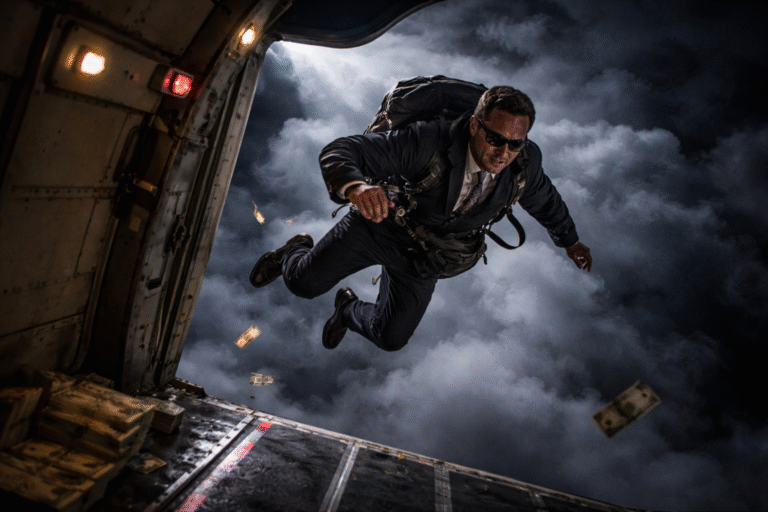
The Man Who Jumped From a Plane and Vanished
The cold sting of November air slapped the cabin as the Boeing 727 roared into motion. On the afternoon of November 24, 1971, the day before Thanksgiving, a man in a dark suit and sunglasses bought a ticket for Northwest Orient Flight 305 from Portland to Seattle. He gave his name as Dan Cooper. He carried a briefcase and looked like an ordinary businessman. Nobody paid much attention to him. Two hours later, this man would jump out of an airplane with $200,000 in cash strapped to his body and disappear forever. Despite one of the largest investigations in FBI history, nobody knows who he really was or what happened to him. The case remains unsolved more than fifty years later.
On the afternoon of November 24, 1971, the day before Thanksgiving, a man in a dark suit and sunglasses bought a ticket for Northwest Orient Flight 305 from Portland to Seattle. He gave his name as Dan Cooper. He carried a briefcase and looked like an ordinary businessman. Nobody paid much attention to him. Two hours later, this man would jump out of an airplane with $200,000 in cash strapped to his body and disappear forever. Despite one of the largest investigations in FBI history, nobody knows who he really was or what happened to him. The case remains unsolved more than fifty years later.
The flight took off at 2:50 p.m. with 36 passengers and six crew members aboard. Shortly after takeoff, Cooper handed a note to a flight attendant named Florence Schaffner. She assumed it was his phone number and put it in her pocket without reading it. Cooper leaned close and said quietly, “Miss, you’d better look at that note. I have a bomb.” Startled, Schaffner’s eyes widened as she fumbled to retrieve the note. Her hands trembled slightly as she unfolded the paper, her mind racing. Schaffner’s voice quivered when she whispered, “What do you want from us?”
Schaffner opened the note. It said he had a bomb in his briefcase and wanted her to sit next to him. Cooper opened his briefcase slightly so she could see inside. She glimpsed red cylinders, each about the size of a roll of coins, tightly packed alongside a tangle of colored wires and a battery that looked ominously solid. It looked like a bomb. Cooper stated his demands calmly: he wanted $200,000 in twenty-dollar bills, four parachutes, and a fuel truck waiting in Seattle. He said if his demands were not met, he would blow up the aircraft.
The pilot radioed Seattle and explained the situation. The airline president immediately agreed to Cooper’s demands. While the plane circled above Seattle for nearly two hours, FBI agents and airline officials gathered the cash and parachutes. Bank employees photographed the serial numbers of every bill so the money could be traced. By 5:30 in the evening, everything was ready.
The plane landed at Seattle-Tacoma Airport. Cooper allowed all 36 passengers to leave. The flight attendants brought the money and parachutes on board. Cooper checked everything carefully. He examined the parachutes as if he were familiar with skydiving equipment. He selected a military-style parachute and a reserve chute.
Cooper then gave new instructions. He wanted the plane to fly to Mexico City under specific conditions: below 10,000 feet, at the slowest possible speed, with the wing flaps lowered and the landing gear down. The pilots planned to refuel in Reno, Nevada. Cooper kept two flight attendants and the flight crew but released the others. At approximately 7:40 in the evening, the plane took off again, heading south.
Cooper ordered the remaining flight attendants to go to the cockpit and stay there. Around 8:00 PM, a warning light indicated that the aircraft’s rear stairs had been deployed. The Boeing 727 had stairs that could be lowered from inside the cabin during flight. The crew felt a change in air pressure. At approximately 8:13 PM, the plane’s tail suddenly lifted upward, suggesting that a significant weight had left the aircraft.
Cooper had jumped.
When the plane landed in Reno, police searched the cabin. Cooper was gone. He had left behind his tie, a tie clip, eight cigarette butts, and two parachutes. The money and the man had vanished into the night sky somewhere over the wilderness of Washington state.
The FBI investigation began immediately. They called him D.B. Cooper, a name that came from a media mistake, and the wrong name stuck. The FBI interviewed hundreds of people and searched vast areas of forest and mountains. They found nothing.
The jump itself was extraordinarily dangerous. Cooper jumped at night, in a rainstorm, wearing only a business suit and dress shoes. The temperature outside was seven degrees below zero, with wind chill making it feel even colder, potentially dropping the effective temperature to minus forty. The wind speed was 200 miles per hour, creating a wind chill that can cause frostbite in minutes. Hypothermia could set in swiftly when exposed to such conditions. To make matters worse, he jumped over heavily forested wilderness with mountains, rivers, and virtually no roads. Most experienced skydivers said the jump was nearly suicidal. Landing safely would require incredible skill and luck.
Three main theories emerged. The first is that he died during the jump. Perhaps the parachute malfunctioned, or he was knocked unconscious by the violent wind and cold. The wilderness where he jumped is dense and difficult to search. A body could remain hidden for decades.
The second theory is that he survived but died later from exposure. Even if he had landed successfully, he would have been in the remote wilderness, in freezing conditions, wearing only a business suit, possibly injured. Surviving the night would have been nearly impossible.
The third theory is that he survived and escaped with the money. Cooper seemed calm, confident, and knowledgeable. Perhaps he was an experienced skydiver who carefully planned everything. Perhaps he had help waiting on the ground.
In 1980, nine years after the hijacking, a boy found $5,800 in deteriorating twenty-dollar bills buried along the Columbia River. The serial numbers matched Cooper’s ransom money. How did the money get there? Had it washed downstream? Had Cooper buried it himself, or did someone else stash the cash to mislead investigators? The discovery proved the money had been in that area, but it didn’t solve the mystery.
Over the years, several people claimed to be D.B. Cooper or knew his identity. The FBI investigated each claim carefully. None could be confirmed. In 2016, after 45 years of investigation, the FBI officially closed the case.
Why does this case still fascinate people? Perhaps because Cooper succeeded where almost everyone else failed. He is the only hijacker in American history to have never been caught. He outsmarted the FBI and vanished completely. The story has inspired books, movies, and countless theories.
Some see Cooper as a folk hero who beat the system. Others see him as a dangerous criminal who got what he deserved when he likely died in the wilderness. He was a man who committed a serious crime but was also polite to his hostages, didn’t hurt anyone, and pulled off one of the most audacious escapes in history.
Somewhere in the forests of the Pacific Northwest, the answer to the D.B. Cooper mystery may still exist. Perhaps his remains lie covered by fifty years of fallen leaves. Perhaps the rest of the money is buried under decades of soil. Or perhaps, against all odds, Cooper survived and took his secret to the grave. The mystery remains shrouded in whispers, like the wind rustling through the towering fir trees, carrying secrets only the wild knows. We may never know. And perhaps that’s fitting. Some mysteries are meant to remain unsolved, keeping us wondering what really happened on that cold November night when a man jumped from a plane and disappeared into legend.
Take a moment to think about what you read.
Check your understanding
- On what date did the D. B. Cooper hijacking take place?
A. November 22, 1969
B. November 24, 1971
C. December 24, 1971
D. November 24, 1975 - What name did the hijacker give when he bought his airline ticket?
A. D. B. Cooper
B. Jack Cooper
C. Dan Cooper
D. David Cooper - What were Cooper’s main demands?
A. $100,000 and two parachutes
B. $200,000, four parachutes, and a fuel truck
C. $200,000 and immediate landing in Reno
D. $300,000 and a private jet - What type of aircraft was hijacked?
A. Boeing 747
B. Boeing 707
C. Boeing 727
D. Douglas DC-10 - What clue showed that Cooper had jumped from the plane?
A. The cockpit door opened
B. The engines shut down
C. A warning light showed the rear stairs were deployed
D. Smoke filled the cabin
What discovery was made in 1980 related to the case?
A. Cooper’s parachute was found
B. Cooper’s briefcase was recovered
C. $5,800 of the ransom money was found near a river
D. Cooper’s identity was confirmed
Show answers
Answers:
- b
- c
- b
- c
- c
- c