The Dream of Mars
Why We Must Wait
Why travel to Mars will be hard
Mars has always fascinated us. When people look at that small red dot in the night sky, they imagine walking there, maybe even living there. Scientists share this excitement. Space agencies in several countries have plans and projects aimed at Mars. However, getting humans to Mars is not going to happen in the next few years. The problems we face are bigger than most of us realize.
The first big challenge is distance. Mars is far from Earth, with the closest it gets being around 55 million kilometers away. To put that in perspective, this is equivalent to traveling around Earth’s equator approximately 1,375 times. Such a vast distance means a trip to Mars would take at least six to nine months with current technology. This long journey makes the mission risky. If something goes wrong, astronauts cannot return quickly or get help from Earth. Communication between Earth and Mars can be delayed by several minutes to almost half an hour, so real-time help is not possible in emergencies. Astronauts would spend months in a small spacecraft, unable to come home early or call for help. Once they leave Earth, they are truly on their own.
Cost is another major challenge. Space programs are expensive. Building a spacecraft capable of safely carrying people to Mars would cost hundreds of billions of dollars. There are also costs for food, water, fuel, and equipment. Every kilogram sent to Mars costs thousands of dollars. Governments must decide whether to spend this money on space or use it to solve problems on Earth. Many countries cannot afford such a project, and even wealthy nations must think carefully about their choices.
Health risks make the trip even more dangerous. In space, there is no shield from radiation. The sun gives off radiation that can harm human cells and cause cancer. On Earth, our atmosphere protects us, but in space, astronauts would be exposed to this radiation for months. Scientists are trying to find ways to protect them, such as using water walls or creating magnetic fields, but there is no perfect solution yet. There is also the problem of weak bones and muscles. Without gravity, the human body gets weaker. Astronauts who spend too long in space might not be strong enough to walk when they arrive on Mars.
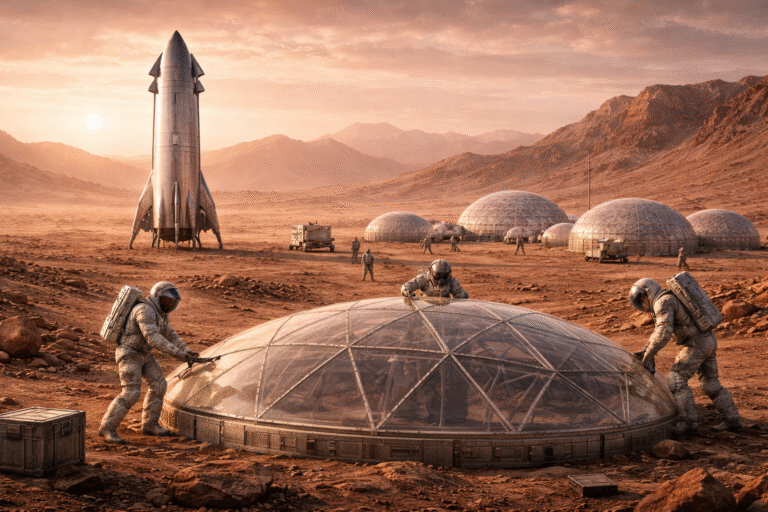
Living on Mars would be hard. The planet has almost no atmosphere, so people cannot breathe there. At night, temperatures can fall to minus 100 degrees Celsius. There is almost no liquid water on the surface. There is no food to eat or wood to burn. Everything would have to come from Earth or be manufactured on Mars using specialised technology still under development. Astronauts would live in sealed buildings and wear space suits whenever they go outside. Even a small mistake, like a tear in a suit, could be deadly.
Rockets are powerful, but not powerful enough to carry everything we need for a Mars mission. We need new engines, new materials, and new systems to recycle air and water. We need ways to produce fuel on Mars so the astronauts can return home. We need better computers and robots to help with the work. All of this technology exists in early forms, but it is not ready for a real mission yet. It will take many more years of testing and improvement.
Perhaps the biggest challenge is not technical but human. Space agencies must work together across borders and cultures. They must share knowledge, money, and resources. But working together is not easy. Countries have different goals, budgets, and ideas about space exploration. Political problems on Earth can delay or halt space projects. Without strong teamwork and commitment from many nations, a Mars mission will stay just a dream.
Robots, such as the Perseverance rover, are exploring Mars, studying rocks, and searching for signs of ancient life. Private companies and national space agencies have developed and tested new spacecraft designs with improved reliability and efficiency. Young engineers and astronauts continue to train for future missions, showing ongoing commitment and capacity-building in the field. Notably, there has been a significant decrease in launch costs with some estimates suggesting up to a 70% reduction since 2000, highlighting the tangible advancements made. While some believe these developments suggest a Mars mission may occur sooner than imagined, significant obstacles remain. The dream is not dead; it remains a distant goal that requires continued progress and patience.
One day, we will go to Mars. But that day is not coming soon. It might not even happen in the next twenty years. The path to Mars is long, costly, and risky. We need to be patient and realistic. We must keep working, learning, and getting ready. Only when we are truly prepared will people finally set foot on Mars and start a new chapter in our story.
Take a moment to think about what you read.
Check your understanding
- How close can Mars get to Earth at its nearest point?
A. About 55 million kilometers
B. About 155 million kilometers
C. About 5 million kilometers
D. About 15 million kilometers - How long would a one-way trip to Mars take with current technology?
A. More than three years
B. Six to nine months
C. A few weeks
D. One to two months - Why is communication during a Mars mission dangerous in emergencies?
A. Communication can be delayed by many minutes
B. Radios do not work in space
C. Astronauts cannot send messages from Mars
D. Earth cannot receive signals from Mars - What health risk is caused by long exposure to space without Earth’s atmosphere?
A. Increased blood pressure
B. Hearing loss
C. Severe allergies
D. Radiation damage to human cells - Why would astronauts have to live in sealed buildings on Mars?
A. Mars has strong gravity
B. Mars has almost no breathable atmosphere
C. Mars has dangerous animals
D. Mars has heavy rainstorms - According to the reading, what is one major non-technical challenge to reaching Mars?
A. Poor public interest
B. The absence of robots
C. The need for international cooperation
D. A lack of trained astronauts
Show answers
Answers:
- a
- b
- a
- d
- b
- c