Joseph Nicephore Niepce
The First Photograph Ever Taken
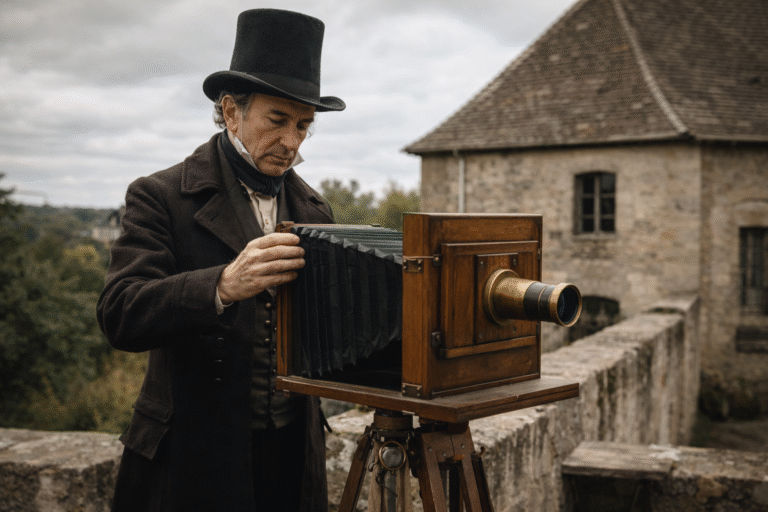
How one determined man invented photography
Imagine the smell of chemicals filling a dimly lit room, mixing with the smell of wood and metal as Joseph Nicephore Niepce carefully prepared his equipment. The sound of wooden shutters echoed softly as they closed, closing the outside world from his small laboratory. Before cameras, the only way to save an image of someone or something was to paint or draw it. Artists would spend hours or even days creating these pictures. Wealthy people often hired artists to paint their portraits. If you wanted to remember a place, you had to draw it yourself or pay someone else to do it. But all of this changed.
Joseph Nicephore Niepce lived in France in the early 1800s. He was not an artist by trade, but he enjoyed experimenting. He wanted to find a way to make pictures without having to draw or paint. At this time, the world was experiencing many scientific breakthroughs, such as the development of steam power, the harnessing of electricity, and advances in lithography. Niepce, inspired by this wave of innovation, knew that light could change some materials. When light touched certain chemicals, they would turn dark. He wondered if he could use this effect to capture an image.
Niepce spent years working on this problem. He tried many materials and methods, but most of them failed. Still, he kept going. He was patient and careful, writing down everything he learned from each experiment.
At last, in 1826 or 1827, Niepce succeeded. We do not know the exact year because he did not record the date, but it happened around then. He prepared a special plate coated with chemicals and placed it inside a dark box with a small hole. Light passed through the hole and struck the plate. He aimed the box out of his window.
Then he waited. It took a very long time. The exposure time for Niepce’s first photograph is usually said to have been eight or nine hours, based on evidence that sunlight appears to move across the buildings in the image, suggesting a day-long exposure. The plate required a lot of light to capture the image, so the box had to remain completely still and always positioned to the same view.
The view from Niepce’s window was nothing special—just some buildings, a tree, and the sky. But when he finally removed the plate from the box, something incredible had happened. The scene outside was now on the plate. He could make out the shapes of the buildings and the tree. The picture was not very clear; it was blurry and hard to see. Still, it was a real photograph—the first one ever made.
Niepce named his method heliography, a Greek word meaning “writing with the sun.” The sun’s light had created the picture on the plate. No one had drawn or painted it by hand. The image was made solely by light.
The first photograph still exists today and is kept in a museum in Texas. At a glance, it does not look impressive—the image is faint and blurry, and you have to look closely to see the buildings. It appears as a smudged relic, yet it holds monumental significance. Despite its humble appearance, this small, unclear picture redrew human memory and changed the world forever.
After Niepce created the first photograph, others became interested in the idea. Louis Daguerre worked with Niepce for some time, and after Niepce died, Daguerre continued improving the process. He made it faster and more practical. Soon, taking a photograph took only a few minutes, rather than hours or days. Other inventors then developed smaller, easier-to-use cameras and found faster-working chemicals. By the 1850s, many people could have their photograph taken.
Imagine how strange this must have felt to people back then. For thousands of years, people only saw their faces in mirrors or paintings. Suddenly, they could see an exact image of themselves, frozen in time. They could keep a picture of someone who had passed away, see what distant places looked like without traveling, and prove that events really happened by taking a photograph.
Photography changed everything. Artists no longer had to spend all their time making realistic images. News changed because people could now see photos of wars, disasters, and important events. Science changed, as scientists could photograph things too small or too fast to see with the naked eye. Even the way we remember our lives has changed, since we can save pictures of our families, friends, and the places we visited.
All of this began with one man aiming a box out his window and waiting for the sun to do its job. The first photograph was not beautiful or clear, but it was real. That made it one of the most important things ever created.
Take a moment to think about what you read.
Check your understanding
- Who created the first photograph ever taken?
A. Louis Daguerre
B. Thomas Edison
C. Joseph Nicéphore Niépce
D. Leonardo da Vinci - Around what years was the first photograph created?
A. 1790–1795
B. 1826–1827
C. 1845–1846
D. 1860–1861 - How long did the exposure for the first photograph take?
A. A few minutes
B. About one hour
C. Several days
D. About eight or nine hours - What was the subject of the first photograph?
A. A portrait of Niépce
B. A busy street scene
C. The view from Niépce’s window
D. A painted landscape - What name did Niépce give to his photographic process?
A. Daguerreotype
B. Lithography
C. Heliography
D. Photography - Where is the first photograph kept today?
A. A museum in France
B. A private collection in England
C. A university archive in Germany
D. A museum in Texas
- Who created the first photograph ever taken?
Show answers
Answers:
- c
- b
- d
- c
- c
- d