Percy Fawcett and the Lost City of Z
Disappearing into the Green Hell
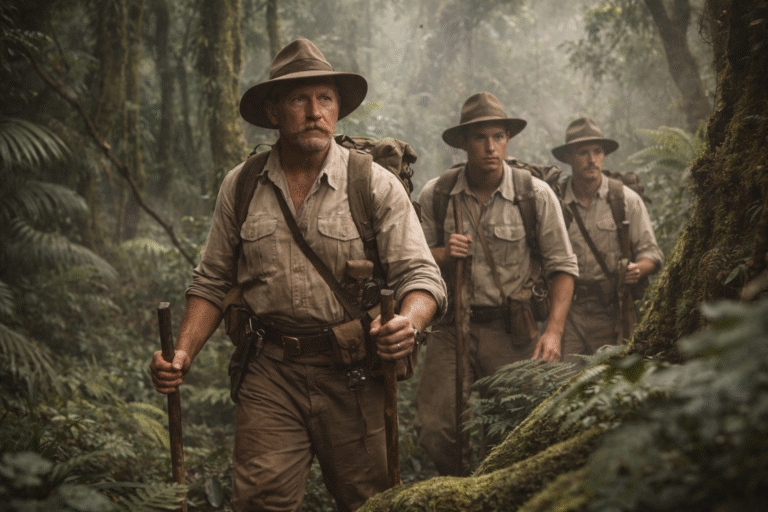
In 1925, British explorer Percy Fawcett entered the Amazon rainforest with his son and a friend, embarking on what would become a race against the relentless passage of jungle time. They were searching for a lost city Fawcett believed was hidden deep in the jungle, which he called the City of Z. Fawcett sent a final message saying they were heading into unknown territory, and then he vanished. No one ever saw Percy Fawcett, his son Jack, or their friend Raleigh Rimell again. In the following decades, more than a hundred people searched the Amazon for them, and some of these searchers also disappeared. The mystery of what happened to Fawcett is still unsolved. His story leaves us wondering: was he chasing an impossible dream, or was there really a lost city out there?
Percy Fawcett was more than just a dreamer. He was a respected military officer and surveyor who spent years mapping unknown parts of South America. From 1906 to 1924, he made seven trips into the Amazon. He survived diseases, hostile tribes, dangerous animals, and the harsh rainforest. Other explorers died on trips that Fawcett finished. He became known as one of the toughest men of his time.
On his trips, Fawcett heard local people talk about ancient cities hidden in the forest. They described ruins with stone buildings and roads. Most Europeans then thought the Amazon was just empty wilderness with only small tribes. But Fawcett started to question this. He found pottery and artifacts that seemed too advanced for small villages. He also found earthworks and signs of large farms. The jungle was hiding something.
In 1920, Fawcett found a document in Brazil’s National Library written by a Portuguese explorer in 1753. It described ruins of a large stone city in the jungle, with tall buildings, wide streets, statues, and carved symbols on the walls. Most historians thought this was just a fantasy, but Fawcett believed it was real. He became obsessed with finding this lost city, which he called Z. He thought finding it would be the greatest archaeological discovery ever.
In 1925, when he was 57, Fawcett set out on his last expedition. He brought his 21-year-old son Jack and Jack’s best friend Raleigh. Fawcett chose to keep the group small, believing that three determined men could travel faster and more quietly through the forest. He was so sure of his plan that he refused help from the Royal Geographical Society and the Brazilian government.
Before leaving, Fawcett told reporters that if he did not come back, no one should try to find him. The jungle was too dangerous for rescue teams. On May 29, 1925, Fawcett sent his last message from a place called Dead Horse Camp. He wrote that they were heading into unknown territory and that everything was fine. After that, there was only silence.
Months passed with no word. Then years passed. Fawcett’s wife did not believe he was dead. She insisted he was still alive, searching for Z. Many rumors spread. Some local tribes said they saw white men who looked like Fawcett. Others claimed the explorers were killed. A few even said Fawcett found his city and became its king. None of these stories could be proven.
Between 1925 and 1939, more than 13 expeditions entered the Amazon in search of Fawcett. Several ended in disaster. People died from disease, starvation, and attacks by indigenous groups who were tired of foreigners invading their land. The Brazilian government eventually banned expeditions looking for Fawcett, declaring the search too dangerous.
Over the years, different people claimed they had solved the mystery. In 1951, a man named James Lynch came forward with bones he claimed were Fawcett’s, hoping to gain fame and recognition. However, tests showed the bones actually belonged to someone else. Without real proof, the truth stayed hidden.
Modern archaeology has added a new twist. In recent years, satellite imagery has shown that the Amazon was not always empty. Long ago, large and complex societies lived there. They built earthworks, established large farms, and had thousands, or even millions, of people. The jungle covered these places after European diseases killed most of the local people in the 1500s and 1600s. So, Fawcett was partly right. There were ancient civilizations in the Amazon. They were not from Atlantis, and they probably did not build stone cities just as he imagined, but they were real and important.
The most likely explanation is that he and his companions died from disease, starvation, or conflict with indigenous groups. The Amazon is unforgiving to those who do not respect its dangers. Fawcett was old, and the two young men were inexperienced. They may have simply run out of supplies or gotten lost. After nearly a century, any physical traces are long gone.
Still, the mystery lasts because it speaks to something deep in us. We want to believe in hidden places and lost worlds. We admire people who chase impossible dreams. Fawcett shows both the bravery and the risk of exploring the unknown. He gave up everything, even his life, for a dream that was part real and part fantasy. His story makes us wonder: when does determination turn into obsession? And most of all, if Fawcett had found his city, would it have been worth the cost? Percy Fawcett remains buried, waiting like the lost city he spent his life trying to find. What secrets still breathe beneath the canopy?
Take a moment to think about what you read.
Check your understanding
- In what year did Percy Fawcett disappear in the Amazon rainforest?
A. 1915
B. 1920
C. 1925
D. 1930 - Who accompanied Percy Fawcett on his final expedition?
A. Two military officers
B. His wife and a surveyor
C. His son Jack and Jack’s friend Raleigh Rimell
D. Members of the Royal Geographical Society - What was the name Fawcett gave to the lost city he was searching for?
A. El Dorado
B. Atlantis
C. Machu Z
D. The City of Z - From where did Fawcett send his last known message in 1925?
A. Manaus
B. Dead Horse Camp
C. Rio de Janeiro
D. Brazil’s National Library - Why did Percy Fawcett refuse help from governments and organizations on his final trip?
A. He did not trust maps
B. He believed a small group could travel faster and quietly
C. He had no funding
D. He planned to return quickly - What has modern archaeology shown about the Amazon region?
A. It was always empty wilderness
B. It contained ancient, complex societies
C. It was home only to nomadic tribes
D. It was settled by Europeans in ancient times
Show answers
Answers:
c
c
d
b
b
b