The Lost Colony of Roanoke
A 400-year mystery
In 1587, over one hundred English men, women, and children landed on a small island near today’s North Carolina. The island was called Roanoke. They came to begin new lives, hoping to build homes, grow food, and start the first lasting English town in America.
The group’s leader was John White. He was also an artist who painted landscapes and portraits of the native people who lived there. White’s own daughter, Eleanor, was among the settlers. Soon after arriving, Eleanor gave birth to a baby girl named Virginia. She was the first English child born in America.
Life on Roanoke Island was hard from the beginning. The settlers got there too late in the year to plant crops, so food soon ran low. The nearby native people were not always friendly. Some had fought with earlier English visitors and did not trust the new arrivals.
The settlers realized they needed help. They asked John White to return to England for more supplies and people. White did not want to leave his daughter and granddaughter, but he knew the colony could not survive without help. In late August 1587, he left Roanoke and promised to come back as soon as he could.
But White could not return soon. When he got to England, the country was getting ready for war with Spain. The Spanish navy planned a big attack, so the Queen ordered all ships to stay and fight. The war delayed White’s trip back to Roanoke for months. He tried many times to get permission to return, but he could not. Finally, in August 1590, three years after he left, White was able to sail back to the island.
When White’s ship reached Roanoke, he felt excited and nervous. He had not seen his family in three years. As the boat got close to shore, the men fired their guns and played loud music to let everyone know they had arrived. They hoped the settlers would hear and come to the beach, but no one came.
White and his men went onto the island. The settlement was empty. All the houses were gone, and the area was silent. No one was there. White walked through the place where the town had been, calling out names, but no one answered.
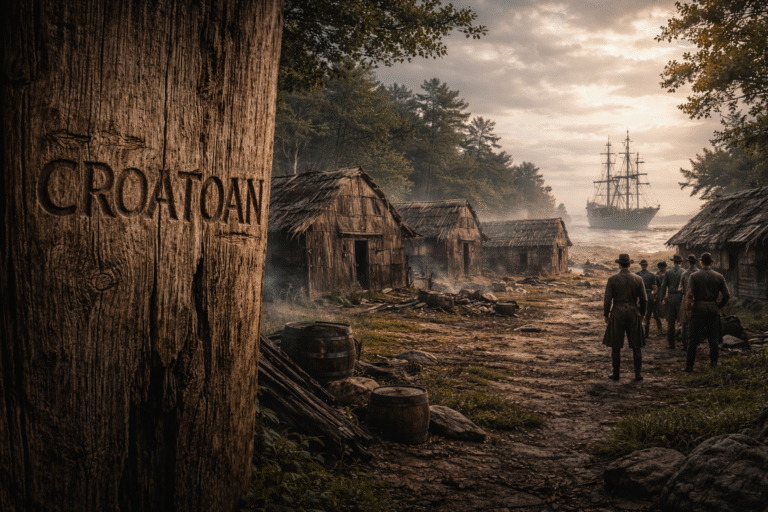
Then White noticed something carved into a wooden post. The word “CROATOAN” was cut deep into the wood. This gave White a bit of hope. Croatoan was the name of another island to the south and also the name of a group of native people who had been friendly to the English. Before White left three years earlier, he and the settlers had made a plan: if they had to leave, they would carve the name of their new location. If they were in danger, they would also carve a cross. There was no cross on the post.
White wanted to sail to Croatoan Island right away to look for his family and the other settlers. But a terrible storm hit, and the wind and waves were too strong. The ship’s captain said they had to leave. White begged to stay, but the captain said no. The ship sailed back to England, and White never returned to America. He never saw his daughter, his granddaughter, or any of the settlers again.
What happened to the lost colony of Roanoke? No one knows for sure. Some believe the settlers went to live with the Croatoan people and joined their community. Others think they were killed by unfriendly native groups. Some say they tried to sail back to England in small boats and died at sea. A few think they walked north and joined other native communities.
Over the years, people have told stories about native people in the area with gray eyes and light hair. Some believed these were the children and grandchildren of the Roanoke settlers, but no proof was ever found.
Archaeologists are still searching for clues. They dig in the ground, looking for things the settlers left behind. Sometimes they find small items like a piece of metal or a broken tool. But they have never found enough evidence to fully solve the mystery.
The lost colony of Roanoke is still one of America’s biggest unsolved mysteries. More than four hundred years have passed, but what happened to the 115 people who disappeared is still unknown. The lack of clear evidence keeps historians and archaeologists interested and shows how complex and uncertain early colonial times were in North America.
Take a moment to think about what you read.
Check your understanding
- In what year did the English settlers arrive on Roanoke Island?
A. 1607
B. 1590
C. 1587
D. 1619 - Who was the leader of the Roanoke colony?
A. John White
B. Walter Raleigh
C. John Smith
D. Francis Drake - Why did John White return to England after the settlers arrived?
A. To escape conflict with native people
B. To bring more supplies and settlers
C. To report the colony’s success
D. To paint landscapes for the Queen - How long was John White gone before he returned to Roanoke Island?
A. One year
B. Two years
C. Four years
D. Three years - What word did John White find carved into a wooden post at the abandoned settlement?
A. VIRGINIA
B. ROANOKE
C. CROATOAN
D. ENGLAND - Why was John White unable to search Croatoan Island after finding the message?
A. He became ill
B. The settlers warned him not to follow
C. His ship had run out of supplies
D. A powerful storm forced the ship to leave
Show answers
Answers:
- c
- a
- b
- d
- c
- d