Marie Curie: A Life in Science
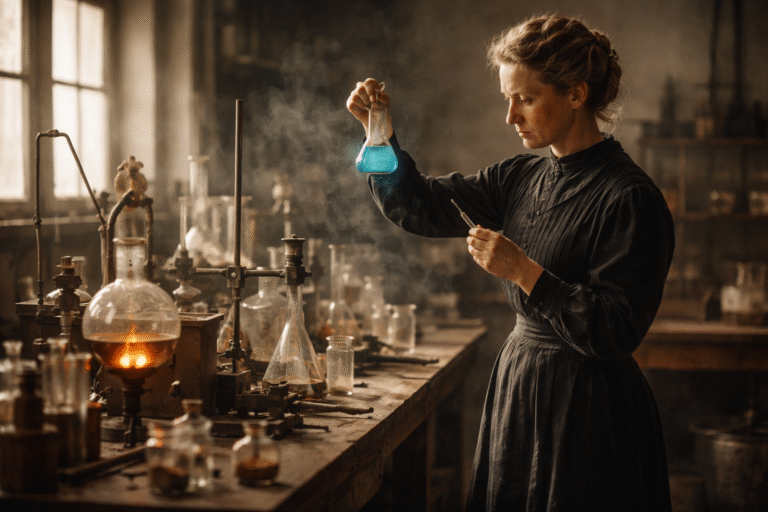
A short reading about how one woman changed science.
Marie Curie was born in Poland in 1867, and her real name was Maria. When she was growing up, Poland was under foreign rule, and life was difficult for her family. Maria loved learning and read every book she could find. However, women were not allowed to attend university in Poland then, which made her sad. She often watched male students enroll and wondered why she couldn’t join them. More than anything, this only strengthened her resolve to pursue science.
At age 24, Maria moved to Paris, France, where she could finally study at a university. She had very little money and lived in a small room at the top of a building. Sometimes, she did not have enough food to eat, but she kept studying and worked harder than anyone else.
While at university, Maria met Pierre Curie, another scientist. They fell in love and got married, and from then on, she was known as Marie in French. Marie and Pierre worked together in the same laboratory, hoping to discover something new about the world.
Around that time, scientists noticed something unusual: some rocks gave off a special kind of energy, but no one knew why. Marie decided to study these rocks. She worked for many years, testing one rock after another. The work was difficult and took a long time.
Eventually, Marie made an important discovery. The rocks contained special materials that continuously emitted energy. She called these materials radioactive. Marie found two new elements that no one had known about before. She named one polonium, after her home country, and the other radium. This work was very important and changed how scientists understood the world.
The discovery of polonium and radium laid the groundwork for modern cancer therapies. Today, treatments like radiotherapy, which use these radioactive elements to target and destroy cancer cells, trace directly back to Marie’s pioneering work. This lasting impact illustrates the profound importance of her discoveries beyond the laboratory.
Marie won the Nobel Prize for her work, becoming the first woman ever to receive this top honor in science. She continued studying radioactive materials even after Pierre died in an accident. She worked even harder and, a few years later, won another Nobel Prize. She was the first person ever to win two Nobel Prizes.
During the First World War, Marie wanted to help. She knew that X-rays could help doctors see inside the body and save lives. She put X-ray machines in cars and brought them to the front lines, teaching doctors how to use them. Her efforts helped save many soldiers.
Marie Curie died in 1934 at the age of 66. Years of working with radioactive materials had made her ill, but her work changed the world. Today, doctors use radioactive materials to help patients, and scientists build on her ideas to make new discoveries. Her daughter also became a scientist and won a Nobel Prize. Marie showed that women can achieve great things in science. She never gave up, even when life was difficult, and she always worked with passion for what she believed in. That is why people still remember her today.
Take a moment to think about what you read.
Check your understanding
- In which country was Marie Curie born?
A. France
B. Germany
C. Russia
D. Poland - Why was Maria unable to attend university in Poland when she was young?
A. Her family could not afford it
B. Women were not allowed to attend university
C. Universities were closed at that time
D. She needed to work to support her family - What did Marie Curie name the materials that continuously gave off energy?
A. Electric
B. Chemical
C. Radioactive
D. Magnetic - Which two elements did Marie Curie discover?
A. Uranium and thorium
B. Polonium and radium
C. Hydrogen and oxygen
D. Gold and silver - What major achievement made Marie Curie unique in Nobel Prize history?
A. She won the Nobel Prize in literature
B. She was the youngest Nobel Prize winner
C. She won a Nobel Prize with her daughter
D. She was the first person to win two Nobel Prizes - How did Marie Curie help during the First World War?
A. She trained nurses at hospitals
B. She developed new medicines
C. She used X-ray machines to help doctors treat soldiers
D. She worked as a battlefield surgeon
Show answers
Answers:
- d
- b
- c
- b
- d
- c