Professional Graded Reading Level 2
The Container Ship That Blocked Global Trade
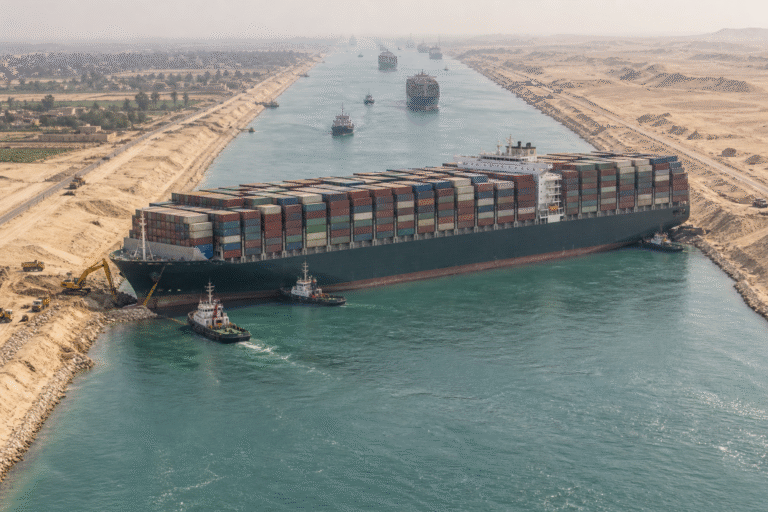
An enormous ship became trapped in the Suez Canal and disrupted businesses and supply chains around the world.
A Shortcut Between Two Seas
The Suez Canal is one of the most important trade routes in the world. It crosses Egypt and connects the Mediterranean Sea with the Red Sea. Ships traveling between Asia and Europe can use the canal instead of sailing around the southern end of Africa.
This shortcut reduces the duration and cost of each journey. It is especially valuable for container ships carrying manufactured goods, machinery, food, clothing, and medical supplies. About 80 percent of the goods consumed worldwide are transported by ships, and a substantial share of trade between Asia and Europe passes through the Suez Canal.
The canal is long and narrow. Ships must follow a controlled route, and there are few places where one vessel can pass another. This system usually operates efficiently. However, it also means that a single accident can stop traffic in both directions.
On March 23, 2021, that is exactly what happened.
The “Ever Given” Turns Sideways
The *Ever Given* was one of the largest container ships in operation. It was almost 400 meters long and carried thousands of containers. The vessel was traveling north through the Suez Canal on its way from China to the Netherlands.
Strong winds and a sandstorm reduced visibility as the ship entered a narrow part of the canal. The *Ever Given* moved away from the center of the channel. Its front end struck one side of the canal, while its back end moved toward the other.
Within minutes, the enormous ship was positioned across almost the entire waterway. Its front section was stuck firmly in the sand and earth beside the canal. The ship had become a barrier between the Red Sea and the Mediterranean.
Traffic stopped immediately. Ships already inside the canal could not continue, while vessels approaching from either direction had to wait.
A Growing Line of Ships
At first, shipping companies hoped the blockage would be removed quickly. However, the size and weight of the *Ever Given* made the assignment extremely difficult.
Each hour brought additional vessels carrying oil, gas, food, raw materials, machinery, and consumer goods. Within several days, hundreds of ships were waiting. Some were positioned near the canal, while others remained at ports or changed their routes.
Every delayed ship affected a larger distribution system. A container might hold parts required by a factory in Germany, clothing intended for a retailer in France, or electrical equipment ordered by a customer in Britain. If the shipment arrived late, production could stop, inventory could fall, and delivery deadlines could be missed.
The blockage occurred during the COVID-19 pandemic, when international shipping was already experiencing container shortages, crowded ports, and high transportation costs. The accident placed further pressure on a system that had little additional capacity.
The Race to Free the Ship
Egypt’s Suez Canal Authority directed the operation to release the “Ever Given”. Specialist teams, contractors, and the ship’s crew worked together day and night.
Small but powerful tugboats attempted to pull and push the ship away from the canal bank. At the same time, digging machinery removed sand from around its front section. Special vessels also removed material from beneath the ship.
The teams had to coordinate their actions accurately. Pulling too hard in the wrong direction could damage the ship. The containers were placed high above the water, so the vessel had to remain balanced. Workers also needed to minimize the risk of an oil leak or other environmental damage.
Another possible solution was to remove fuel, water, or containers to reduce the ship’s weight. However, unloading containers would require large equipment and might take a long time. The rescue teams continued trying to free the vessel without using that slower process.
Progress was difficult to measure. The ship moved slightly, but its front remained trapped. Each failed attempt increased concern about the growing line of waiting vessels.
Help from the Moon
The rescue team expected the water level to rise because of the position of the moon. Higher water would provide additional support beneath the ship and make it easier to move.
On March 29, after almost a week of work, the combination of digging, pulling, and higher water finally produced a successful result. The back of the ship moved away from the bank. Later that day, the entire vessel was floating again.
The “Ever Given” was moved to a wider area of the canal for inspection. Authorities needed to verify that it was safe and that the canal had not suffered serious damage.
Traffic then began moving again. The waiting ships could not all enter the canal at once, so the Suez Canal Authority had to manage their departure carefully. Clearing the accumulated traffic required several more days.
Effects Beyond the Canal
Some shipping companies had already selected another route around Africa. This journey was much longer and required additional fuel. Companies had to choose between waiting at the canal and accepting the cost of a major change in direction.
The delay affected shipping rates and insurance costs. Businesses waiting for merchandise faced unexpected shortages. Manufacturers that depended on regular deliveries had to adjust their schedules. Some customers waited longer for products they had ordered.
Not every delayed container caused an immediate problem. Large distribution networks often hold extra inventory to protect against short interruptions. However, the incident demonstrated that global trade depends on a limited number of important routes.
The Suez Canal is what trade experts call a strategic narrow passage. Such a route increases efficiency when it operates normally, but it also creates a point of risk. If that single point is blocked, the effects can spread across countries and industries.
A Worldwide Lesson
The “Ever Given” blockage lasted less than one week, but it revealed the close connection between modern businesses. A ship in Egypt could affect a factory in Europe, a retailer in North America, or a purchaser waiting for goods from Asia.
The incident encouraged companies to examine their supply chains. Some considered using more than one provider or keeping additional inventory. Others reviewed alternative shipping routes and emergency plans.
The event also demonstrated the value of coordinated professional expertise. Tugboat crews, engineers, canal workers, contractors, and government authorities all contributed to the successful operation.
One ship had blocked a route used by thousands of businesses. Freeing it required careful planning, suitable machinery, favorable natural conditions, and continuous teamwork. When the *Ever Given* finally moved, it did more than reopen a canal. It allowed a major part of the worldwide distribution system to begin moving again.
Take a moment to think about what you read.
Vocabulary Help
Gloss
- canal — a human-made waterway used by ships or for carrying water
- blockage — something that prevents movement through a place
- shortcut — a quicker or more direct route to a destination
- interruption — an event that temporarily stops an activity or process
- pandemic — a disease that spreads across many countries or large parts of the world
- reopen — to open again after being closed
- sandstorm — strong wind that carries large amounts of sand through the air
- sideways — toward or from one side rather than straight ahead
- teamwork — the activity of people working together to achieve a shared goal
- unload — to remove goods or other items from a vehicle, ship, or container