Professional Graded Reading Level 2
The Race to Rescue the Chilean Miners
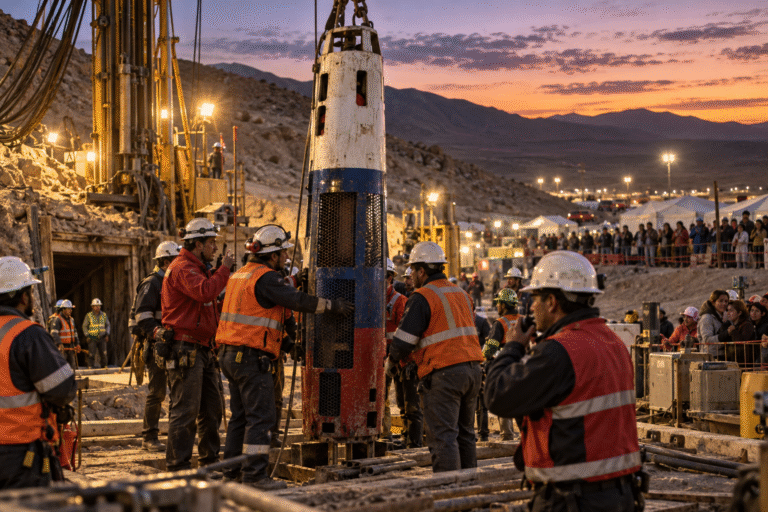
Discover how engineers, medical experts, and rescue workers worked together to bring 33 trapped Chilean miners safely back to the surface.
A Sudden Collapse
On August 5, 2010, part of the San Jose mine in northern Chile suddenly collapsed. Thirty-three miners were working deep below the Atacama Desert. The falling rock blocked the main passage, leaving the men about 700 meters below the surface.
At first, nobody knew whether they were alive. Rescue workers tried to enter through an older passage, but further movement inside the mine made this too dangerous. They therefore began drilling narrow holes from the surface. Their goal was to reach the underground area where the miners might have gathered.
The operation was extremely difficult. The rescuers did not know the miners’ exact location, and their equipment had to pass through hundreds of meters of hard rock. Several early attempts failed.
A Message from Below
For seventeen days, the miners had no contact with the outside world. They had found safety in an underground room, but their food supply was limited. They carefully divided a small amount of tuna, milk, and other goods among the entire group.
On August 22, a drill finally reached the area near them. When workers pulled it back to the surface, they discovered a message attached to it. Written in red ink, it announced that all thirty-three men were alive.
The news quickly spread worldwide. Families who had been waiting beside the mine celebrated, but the most difficult part of the assignment had only begun. The small hole could deliver supplies, but it was not wide enough for a person. Engineers needed to design a safe method of bringing every miner to the surface.
Supporting Thirty-Three Men
Workers widened the narrow opening and installed tubes through which they could send water, food, medicine, clothing, and letters. Telephone and video equipment allowed the miners to speak with their families and the rescue team.
Life below the surface required strict organization. The miners divided their underground space into separate areas for sleeping, working, and waste disposal. They followed a daily calendar and completed regular assignments. They also exercised so that they would remain healthy enough to enter the rescue equipment.
Medical experts controlled their food consumption carefully. Giving too much food too quickly after a period of near starvation could have caused serious health problems. Each man’s condition therefore had to be checked accurately and consistently.
The Chilean authorities also requested guidance from NASA. Astronauts often live for long periods in small spaces, far from ordinary help. A NASA team provided expertise in medicine, mental health, nutrition, and engineering. Its members advised the rescuers on how to support the miners during their long stay and helped establish specifications for the rescue capsule.
Three Plans
The government did not depend on a single solution. Three drilling operations, called Plans A, B, and C, began working toward the miners. This strategy improved the possibility of success if one machine experienced a defect or could not continue.
Plan B made the fastest progress. However, drilling a passage wide enough for the rescue capsule required careful calculation. The drill did not always travel in a perfectly straight line, and the rock removed from above could fall into the miners’ space. The men below helped clear this material while the workforce above continued operating the machinery day and night.
Engineers repeatedly inspected the passage. They had to verify its width, direction, and stability before authorizing the final rescue. Any major error could damage the equipment or cause another collapse.
The Fenix Capsule
The rescue team developed a narrow metal capsule called Fenix, the Spanish name for the phoenix—a bird that rises again. The capsule was just large enough to carry one person. It had wheels along its sides to reduce contact with the rock and an oxygen supply for unexpected problems.
Each journey through the passage would take several minutes. If the capsule became trapped, the miner needed a possible method of escape. Communication equipment allowed workers to monitor the passenger throughout the journey.
Before the rescue began, the system was tested. Then a rescue worker traveled down to the miners. His arrival demonstrated that the equipment was operating correctly and gave the men confidence in the plan.
The Journey Up
Shortly after midnight on October 13, Florencio Avalos entered the capsule. He was selected to travel first because he was considered calm and physically fit. As the capsule reached the surface, his family, rescue workers, and government officials waited nearby. Millions of people watched the event through worldwide media.
One by one, the remaining miners made the same journey. The order was strategic. Strong and experienced men came first, followed by miners who had health concerns. Those judged strongest remained below until the final stage.
The rescue continued for more than twenty hours. Every trip involved risk, but the capsule completed each journey successfully. Luis Urzua, the group’s supervisor during the emergency, was the last miner to leave. When he reached the surface, all thirty-three men had been rescued.
A Shared Achievement
The miners had spent sixty-nine days underground. Their survival depended on discipline, cooperation, and hope. The rescue depended on an even wider effort involving miners, engineers, medical experts, government authorities, contractors, and international advisers.
No single person or piece of machinery completed the operation. Its success came from coordinating many different forms of expertise. Problems were examined carefully, plans were adjusted when necessary, and several solutions were developed at the same time.
The rescue of the Chilean miners became more than a national event. It showed how organized teamwork, technical knowledge, and determination could overcome an extraordinary emergency. After more than two months below the desert, every miner returned to the surface
Take a moment to think about what you read.
Vocabulary Help
Gloss
- miners — people whose job is to remove coal, metals, or other materials from beneath the ground
- capsule — a small enclosed container designed to carry or protect a person
- miner — a person who works in a mine
- underground — below the surface of the earth
- drilling — making a deep hole with a machine or tool
- drill — a machine or tool used to make holes
- rescuers — people who save others from dangerous situations
- astronauts — people trained to travel and work in space
- ink — colored liquid used for writing or printing
- inspect — to examine something carefully to check its condition or quality