Professional Vocabulary Level 2
The Computer Error That Almost Started a Nuclear War
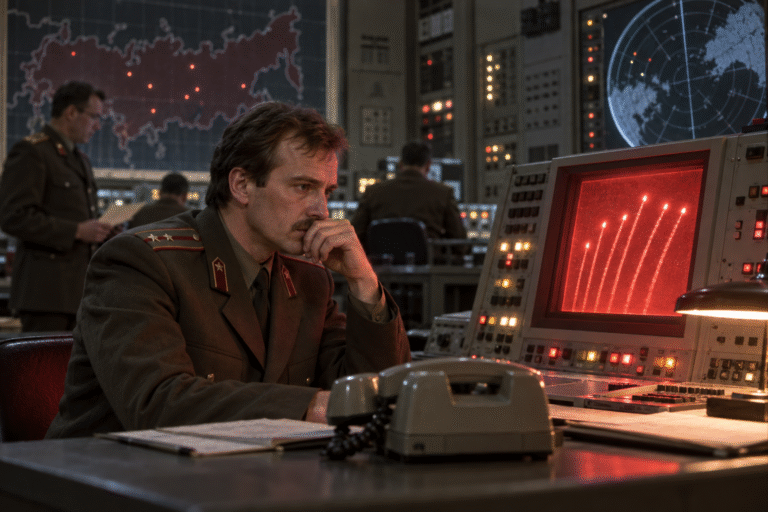
One officer’s careful judgment prevented a false computer warning from becoming a global nuclear disaster.
A Dangerous Time
On the night of September 26, 1983, Stanislav Petrov arrived for work at a secret military center near Moscow. He was an officer in the Soviet Union’s air defense forces. His assignment was to supervise a new warning system designed to identify a nuclear attack.
This was an especially dangerous period in the Cold War. The United States and the Soviet Union had thousands of nuclear weapons aimed at each other. Relations between them were extremely poor. Only three weeks earlier, Soviet forces had shot down a Korean passenger plane that had entered Soviet airspace. All 269 people on the plane had died.
Both countries feared that the other might launch a surprise attack. Each side therefore developed satellites, computers, and radar systems that could provide an early warning. The systems were supposed to give national leaders enough time to respond before enemy missiles reached their targets.
However, this strategy created a serious risk. Leaders might have only a few minutes to decide whether a warning was valid. A single error could have a worldwide impact.
The Alarm
Shortly after midnight, the quiet command center suddenly changed. An alarm sounded, and the word “LAUNCH” appeared on a large screen. The computer indicated that a nuclear missile had left the United States and was traveling toward the Soviet Union.
Petrov and the other officers had been trained for this exact situation. The system had identified the missile with the highest level of confidence. According to official procedure, Petrov was expected to notify his superiors immediately. His report would then be passed through the military command system to the Soviet leadership.
Before he could act, the system reported four more launches. It now appeared that five American nuclear missiles were on their way.
Petrov faced an extraordinary decision. If the warning was accurate and he failed to report it quickly, several Soviet cities could be destroyed without an effective response. If the warning was false and he reported an attack, Soviet leaders might prepare or authorize a nuclear strike against the United States.
Millions of lives could depend on what happened next.
Reasons for Doubt
Although the computer classified the warning as valid, Petrov was not convinced. The number of missiles seemed too small. He believed that if the United States began a nuclear war, it would probably launch hundreds of missiles at the same time. A first attack involving only five missiles did not appear logical.
There was another reason for doubt. Ground radar had not detected any missiles. However, radar could not identify them immediately because they would need time to rise above the horizon. Petrov could not simply wait for complete confirmation. If the attack was real, every minute mattered.
The warning system was also relatively new. Petrov understood its design and knew that even innovative technology could contain an unexpected defect. A computer could process information efficiently, but it could not always explain whether the information made sense.
Around him, alarms continued to sound. Electronic maps and screens showed the possible attack. Other workers waited for his instructions. Petrov later described the pressure as intense, but he had to remain calm.
A Human Decision
Petrov finally notified his superiors that the system was producing a false alarm. This was not a safe or convenient choice. He had no evidence that could completely verify his prediction. He was placing his professional judgment against a costly warning system created by military experts.
Then he waited.
If missiles had actually been launched, they would soon become visible to ground radar. For several long minutes, nobody knew whether Petrov’s decision was correct. Eventually, no missiles appeared. No explosions followed. The computer warning had been false.
Petrov’s judgment had prevented incorrect information from moving quickly through the Soviet command system. It is impossible to know exactly how Soviet leaders would have responded if he had reported a confirmed attack. One officer did not have the authority to begin a nuclear war by himself. Nevertheless, during a period of extreme international tension, his report could have influenced a series of urgent military decisions.
What Caused the Error?
An investigation later examined the incident. The problem was not an American missile but an unusual natural effect. Soviet satellites were designed to recognize the bright heat produced when a missile was launched.
On that night, sunlight reflected from high clouds over an area of the United States. The position of the sun, clouds, and satellites created an image that the system incorrectly identified as a launch. As the satellite continued to observe the area, it reported additional missiles.
The system had processed the available data correctly according to its programming. Its failure was that it could not accurately classify the unusual light. Designers had not expected that particular combination of conditions.
After the incident, engineers made efforts to improve the system and reduce the risk of duplicate warnings. The event demonstrated why important decisions should not depend on one source of information. Satellite reports, radar observations, and human judgment needed to reinforce one another.
Recognition Came Later
Petrov did not immediately receive worldwide recognition. The incident remained secret for years, and details became public only after the Soviet Union ended. Petrov left the military and lived a quiet life outside Moscow.
Later, several organizations honored him for his actions. The media sometimes called him “the man who saved the world.” Petrov did not appear comfortable with this title. He said that he had simply completed his job.
His decision, however, offers an important lesson. Technology can support people, calculate enormous amounts of data, and provide warnings within seconds. Yet no system is perfect. Hardware can fail, information can mislead, and an unexpected situation can produce results that appear completely accurate.
On one tense night in 1983, a computer announced the beginning of a nuclear attack. Stanislav Petrov examined the warning, questioned its logic, and chose not to accept it automatically. The world may never know exactly what would have happened if he had made a different decision. What is certain is that the alarm was false—and that careful human judgment prevented a computer error from becoming something far more dangerous.
Take a moment to think about what you read.
Vocabulary Help
Gloss
- missile — a weapon designed to travel through the air toward a target
- radar — a system that uses radio signals to identify the position and movement of objects
- satellite — an object sent into space to travel around Earth or another planet
- airspace — the area of sky above a country or region
- confirmation — information showing that something is true or correct
- explosion — a sudden, violent release of energy that produces heat, noise, and pressure
- horizon — the distant line where the land or sea appears to meet the sky
- incorrect — not true or correct
- supervise — to watch and direct someone’s work or an activity
- tense — causing worry because something difficult or dangerous may happen