Professional Graded Reading Level 2
The Fall of the Berlin Wall: One Mistaken Announcement
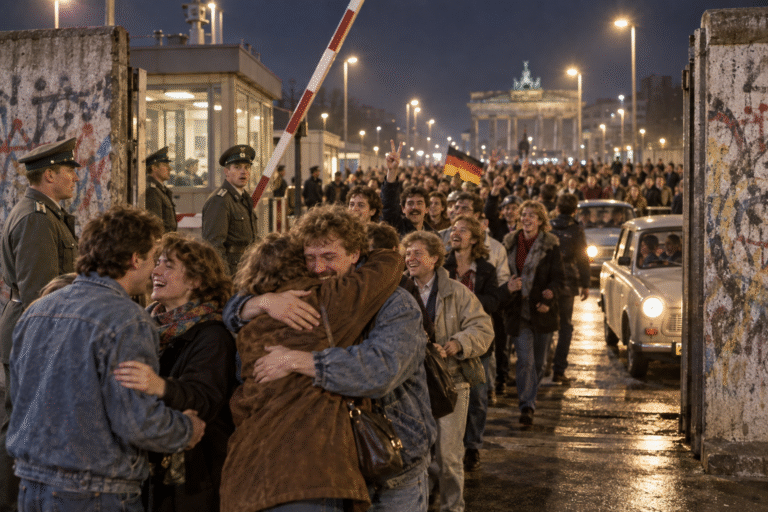
A mistaken announcement sent thousands of East Germans to the border and helped bring down the Berlin Wall.
A Divided City
For almost thirty years, the Berlin Wall divided one of Europe’s greatest cities. After the Second World War, Germany had been separated into two countries. West Germany developed a democratic government and a market economy, while East Germany became a communist state closely connected to the Soviet Union.
Berlin was also divided, although the entire city lay inside East Germany. West Berlin was connected politically to West Germany, while East Berlin served as the capital of East Germany.
Many East Germans wanted to leave the country. Before the Wall was built, millions moved west in search of greater freedom and better opportunities. In August 1961, the East German government closed the border. It constructed a system of concrete walls, fences, guard towers, and controlled areas. Families were separated, workers lost their jobs, and ordinary journeys across the city became impossible.
East German authorities claimed that the Wall protected the country. In reality, its main purpose was to prohibit citizens from leaving.
Pressure for Change
By 1989, communist governments across Eastern Europe were facing increasing pressure. The Soviet Union was introducing reforms, and several neighboring countries had begun to reduce travel restrictions.
Thousands of East Germans found ways to escape through other countries. Many traveled to Hungary, which had opened its border with Austria. Others entered West German government offices in Eastern Europe and requested permission to leave.
Inside East Germany, public dissatisfaction was also growing. Large demonstrations took place in Leipzig, Berlin, and other cities. Protesters demanded free elections, freedom of speech, and the right to travel. The government could no longer ignore the movement.
East German leaders attempted to respond without losing control. They began developing new travel regulations that would make it easier for citizens to apply for permission to go abroad. The rules were supposed to be announced carefully and introduced through an organized administrative process.
That is not what happened.
The Press Conference
On November 9, 1989, Gunter Schabowski, a senior East German official, held a televised press conference. Near the end, he received a document describing the new travel policy. Schabowski had not attended the meeting at which the final details were discussed, and he apparently had not received complete guidance about how the announcement should be made.
He told the journalists that East German citizens would be permitted to travel through the country’s border crossings.
A reporter then asked the most important question: When would the new regulation become effective?
Schabowski examined his papers. After a short pause, he replied that, as far as he knew, it would take effect immediately, without delay.
This was incorrect. The government had intended to distribute the information through its news service the following morning. Citizens were expected to apply for permission, and border officials needed time to receive instructions and prepare for the change.
Schabowski’s uncertain answer made it sound as though the border was already open.
The News Spreads
Journalists immediately recognized the impact of the statement. International media reported that East Germany had opened its borders. Television and radio stations repeated the news throughout Berlin.
East Germans watching at home were surprised. Some were suspicious, but others decided to verify the report themselves. Small groups began arriving at border crossings and asking to pass into West Berlin.
The border guards knew nothing about the new policy. They had received no instructions to open the gates, and they were not authorized to allow everyone through. They telephoned their supervisors, but no clear order arrived.
As the evening continued, the number of people at the border increased substantially. Hundreds became thousands. The crowd repeated Schabowski’s announcement and demanded that the guards follow it.
The situation was extremely dangerous. The guards carried weapons, and the border had previously been controlled with deadly force. If either the crowd or the guards had reacted violently, the peaceful celebration remembered today might have become a disaster.
A Decision at the Border
At the Bornholmer Street crossing, officials tried several tactics to reduce the pressure. They allowed a limited number of people to leave, but the crowd continued to grow. Cars and people filled the surrounding streets.
The guards could not force such a large crowd to return home. They also could not obtain useful guidance from senior authorities. Shortly before midnight, the officials at the crossing finally opened the barrier and allowed people to pass freely.
Other border crossings soon followed.
East Berliners walked and drove into West Berlin, where large crowds welcomed them. People who had been separated for years embraced one another. Strangers celebrated together in the streets. Some climbed onto the Wall, while others began breaking off pieces with simple tools.
The guards mostly stood and watched. A system designed to control millions of people had stopped operating within a few hours.
More Than One Mistake
The Wall did not fall only because Schabowski gave the wrong answer. Years of economic difficulty, public protest, political reform, and pressure from citizens had already weakened the East German government. The new travel policy itself showed that change had become unavoidable.
However, the mistaken announcement affected the timing and direction of events. It created an immediate public expectation that the border was open. Television reports reinforced that belief, and thousands of citizens acted on it before the authorities could organize a response.
Once the crowds crossed peacefully, the government could not easily close the border again. The Wall had lost both its practical function and its political authority.
A Historic Night
Over the following months, sections of the Berlin Wall were removed, and travel between East and West became normal. On October 3, 1990, East and West Germany officially united as one country.
The events of November 9 demonstrate how quickly history can change. Government leaders had planned a controlled adjustment to their travel rules. Instead, unclear communication turned the adjustment into an unexpected opening.
Gunter Schabowski did not independently destroy the Berlin Wall. The courage and determination of East German citizens had created the conditions for change. Nevertheless, his words provided the final push. A document was read incorrectly, the news spread worldwide, and thousands of people went to the border to claim the freedom they had just been told was theirs.
Take a moment to think about what you read.
Vocabulary Help
Gloss
- communist — relating to a political and economic system in which the state controls major property and industry
- mistaken — wrong or based on an incorrect understanding
- courage — the ability to face danger or difficulty without giving up
- dissatisfaction — the feeling of being unhappy because something is not as good as expected
- peaceful — calm and not involving violence
- protesters — people who publicly show that they oppose or disagree with something
- suspicious — feeling that something may be wrong, dishonest, or dangerous
- televised — shown or broadcast on television
- unavoidable — impossible to prevent or escape
- uncertain — not known, definite, or completely sure