Professional Graded Reading Level 2
The Tylenol Crisis That Changed Product Safety
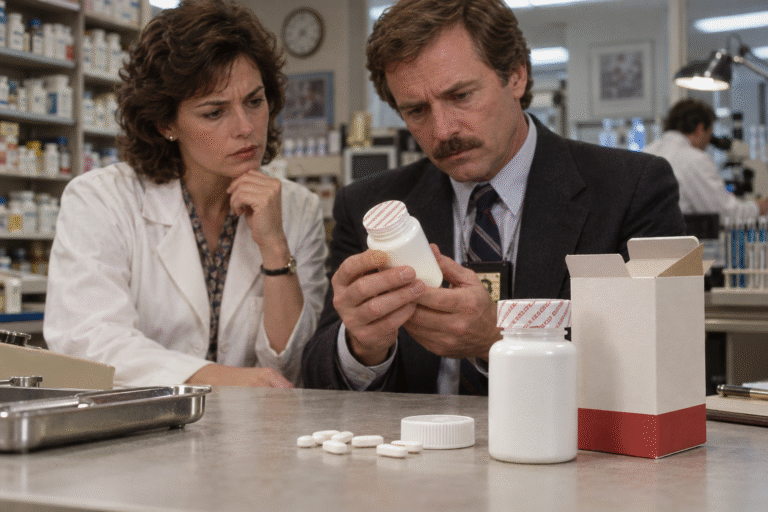
A deadly product crisis led to safer medicine packaging and changed how companies protect their customers.
A Common Medicine
In 1982, Tylenol was one of the most popular medicines in the United States. Millions of people used it to reduce pain and fever. Customers could purchase it without a prescription from supermarkets and other retail outlets.
At that time, medicine containers were less secure than they are today. A bottle might sit inside a simple box, but there were often no clear signs showing whether someone had opened it. Most shoppers did not consider this a serious risk. They trusted that a product on a store shelf was safe.
That assumption changed suddenly in the Chicago area during the final days of September 1982.
A Mysterious Series of Deaths
The emergency began when a twelve-year-old girl became sick after taking an Extra-Strength Tylenol capsule. She died shortly afterward. At first, her death appeared to be an individual medical tragedy.
Within a short period, several other people in the Chicago area also died unexpectedly. Three members of one family became victims after taking capsules from the same bottle. Investigators began to notice an important connection: each person had recently taken Extra-Strength Tylenol.
Tests confirmed that some of the capsules contained cyanide, a highly dangerous poison. In total, seven people died.
The medicine had been safely produced. Investigators believed that someone had removed bottles from store shelves, opened them, placed poison inside some capsules, and then returned the bottles to retail outlets. Because the packages had no effective safety barriers, shoppers could not identify that anything was wrong.
An Immediate Warning
Police, medical workers, and health authorities needed to act quickly. They warned the public not to use Extra-Strength Tylenol capsules. Police vehicles drove through some neighborhoods using speakers to announce the danger.
The manufacturer, Johnson & Johnson, also faced an urgent decision. The poisoned bottles had been discovered in one region, and there was no evidence that every bottle was dangerous. A limited response would have been less costly.
Instead, the company recalled Tylenol capsules across the United States. Retailers were asked to remove the product from their shelves, and customers were told to stop using it. The company provided information to the media and established telephone services to respond to questions.
The recall involved millions of bottles and created an enormous financial loss. However, protecting the public was treated as more important than minimizing the immediate cost.
A Difficult Investigation
The poisoning led to one of the largest product investigations in American history. The FBI worked with state and local police agencies. Nearly 120 investigators participated.
They inspected bottles, examined receipts, interviewed shoppers, and studied where each product had been purchased. They wanted to identify where the poison had entered the distribution system.
Evidence suggested that the capsules had been changed after leaving the factory. The affected bottles had different production numbers and had come through different distribution routes. This made a manufacturing accident unlikely.
A man later demanded one million dollars from Johnson & Johnson in a letter. He was arrested and found guilty of attempting to obtain money through the crisis, but authorities could not prove that he had poisoned the capsules. Nobody was charged with the seven deaths, and the central crime remains unsolved.
Designing a Safer Package
Removing the dangerous products was only the first step. Manufacturers, retailers, and government authorities had to decide how to prevent a similar attack.
Johnson & Johnson introduced new packages with several separate safety features. A sealed box, a plastic band around the bottle, and a cover beneath the cap made unauthorized opening more difficult. More importantly, damage to any of these barriers gave customers visible evidence that the package might have been opened.
The company also replaced many two-part capsules with solid tablets. A capsule could be separated and filled with another substance, while a solid tablet was more difficult to alter.
These changes increased production costs, but they also helped rebuild public confidence. Customers gradually returned to the product because the new package allowed them to inspect it before use.
New National Requirements
The impact extended far beyond one company. In November 1982, the United States Food and Drug Administration issued new regulations for tamper-resistant packaging. These rules applied to medicines sold without a prescription and to certain other consumer products.
A package now needed at least one barrier or indicator that would provide visible evidence if someone had entered it. Manufacturers could use plastic wrapping, a sealed cover, a band around the cap, or individually protected tablets.
Labels also needed to explain the safety feature so that customers would know what to inspect. If the stated seal was missing or damaged, the purchaser should not use the product.
In 1983, the federal government passed an additional law making product tampering a serious crime. Violations could result in long prison sentences, especially when an action caused injury or death.
A Model for Crisis Management
The Tylenol case also changed how businesses responded to public emergencies. Company managers learned that delaying action could increase both the danger and the loss of public trust.
Johnson & Johnson provided frequent updates, cooperated with investigators, and accepted the cost of a nationwide recall. Its response later became a common example in business textbooks. The company could not change what had happened, but it could demonstrate that customer safety was its highest priority.
The case also showed the importance of coordination. Police, medical experts, government officials, laboratories, retailers, and the manufacturer all held different pieces of information. Sharing those details helped authorities classify the deaths correctly and remove products from stores.
The Safety Features We Now Expect
Today, customers commonly open a box, remove plastic from a bottle, and break a seal before reaching the medicine inside. These steps may appear inconvenient, but each one provides protection.
No package can prohibit every possible crime. However, modern packaging makes interference more difficult and easier to detect. It gives shoppers an opportunity to reject a product that does not appear secure.
The seven deaths in Chicago were a terrible and still-unsolved crime. Yet the response transformed product safety throughout the United States. Regulations changed, companies redesigned their containers, and customers learned to inspect seals before using medicine.
The crisis established a new principle: a safe product requires more than safe ingredients. It also needs a package that protects those ingredients throughout the journey from the manufacturer to the customer.
Take a moment to think about what you read.
Vocabulary Help
Gloss
- capsule — medicine contained inside a small case that dissolves after it is swallowed
- investigator — a person who collects and examines information to discover what happened
- inspect — to examine something carefully
- poison — a substance that can cause serious illness or death
- tablet — medicine formed into a small, hard piece
- coordination — the organization of people or activities so that they work together effectively
- nationwide — happening throughout an entire country
- tamper — to interfere with or secretly change something, usually in a harmful way
- resistant — designed to prevent or reduce the effect of something
- urgent — requiring immediate attention or action