Professional Graded Reading Level 1
The Carrington Event: The Solar Storm That Could Shut Down the Modern World
Discover how the sun could disrupt modern life.
A Strange Light on the Sun
On the morning of September 1, 1859, an English scientist named Richard Carrington was studying the Sun. He was drawing a group of dark areas called sunspots when he suddenly saw two extremely bright lights. They appeared over the sunspots, became stronger, and then disappeared within several minutes.
Carrington did not know exactly what he had witnessed. Today, scientists understand that he had observed a powerful solar flare—a sudden release of energy from the Sun.
About seventeen hours later, something remarkable happened on Earth.
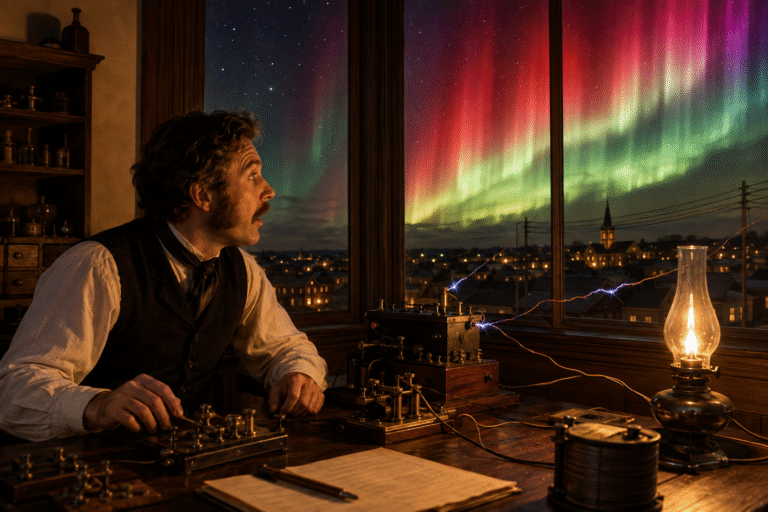
Bright waves of red, green, and purple light appeared across the night sky. These natural lights, known as auroras, are normally seen mainly in northern and southern regions. During this event, however, people saw them much farther from the poles. Some reports said that the sky was so bright that people could read newspapers outside during the night.
The beautiful lights were a warning that a powerful solar storm had reached Earth.
Trouble with the Telegraph
In 1859, there were no satellites, mobile phones, computers, or electrical power networks. However, many countries depended on the telegraph. Messages were sent over long wires by electrical signals. Telegraph communication was essential for governments, newspapers, railways, and businesses.
As the solar storm struck Earth, telegraph systems began to behave strangely. Machines produced sparks, paper caught fire, and some workers received electrical shocks. In several places, operators disconnected their equipment from its normal power supply, but messages continued to travel along the wires. The storm itself was producing electrical current.
The event was later named the Carrington Event after the scientist who observed the bright solar flare. It became the most famous example of powerful space weather affecting human technology.
How Can the Sun Affect Earth?
The Sun does more than provide heat and light. It is an active star that can suddenly release enormous amounts of energy and material.
Sometimes the Sun sends a large cloud of electrically charged material into space. Scientists call this a coronal mass ejection. If the cloud travels in Earth’s direction, it may reach our planet within a few days. The cloud connected with the Carrington Event appears to have travelled unusually quickly.
Earth is surrounded by a magnetic field that helps protect the planet. When charged material from the Sun reaches this field, it can cause a geomagnetic storm. Such a storm may create beautiful auroras, but it can also produce electrical currents in long wires and other equipment.
In 1859, telegraph lines provided a path for those currents. Today, there are many more possible paths.
What Would Happen Today?
Modern life depends on connected systems. Electricity supports homes, hospitals, factories, banks, communication networks, water systems, and transportation. A storm similar to the Carrington Event could therefore create much greater disruption today.
Long power lines might collect electrical current produced by the storm. Important equipment could become too hot or suffer damage. If several major parts of the power system failed at the same time, large areas could lose electricity. Repairing some equipment might take weeks or longer because replacement parts are expensive and difficult to produce.
Satellites would also face danger. Charged material and extra radiation could damage their electronic systems. This could affect weather reports, television services, international communication, and navigation.
Many people use satellite navigation without thinking about it. Ships and airplanes use it to determine their position. Delivery companies use it to plan routes and track vehicles. Farmers use it to operate equipment. Banks and communication systems also depend on exact time information provided by satellites.
A serious failure could therefore spread from one industry to another. A navigation problem could delay transport. Transport delays could interrupt factory supplies. Factories might reduce production, while shops could have difficulty receiving products. Businesses could lose access to computer systems or payment services. The final economic cost could be enormous.
Preparing for the Next Storm
Scientists cannot prevent a solar storm, but they can watch the Sun and provide warnings. Special instruments on Earth and in space observe sunspots, solar flares, and clouds of charged material.
If a dangerous storm is moving toward Earth, satellite operators may delay certain operations or place equipment in a safer condition. Power companies may change how electricity moves through their networks. Airlines may adjust some routes, particularly those near the poles, where communication problems and radiation risks can be greater.
These actions cannot remove every danger, but advance warning can reduce the damage.
A Warning from the Past
No one knows when another storm as powerful as the Carrington Event will strike Earth. Smaller solar storms occur regularly, and most cause limited disruption. However, the events of 1859 show that the Sun is capable of affecting technology across a very large area.
The Carrington Event happened in a world connected mainly by telegraph wires. Our world is far more connected and therefore more exposed. Electricity, satellites, communication, transportation, finance, and international trade all depend on one another.
The bright skies of 1859 were a spectacular natural display. They were also a message from the past: even the most advanced human systems remain connected to—and dependent on—the activity of the Sun.
Take a moment to think about what you read.
Check your understanding
Check Your Understanding
Question 1 of 10